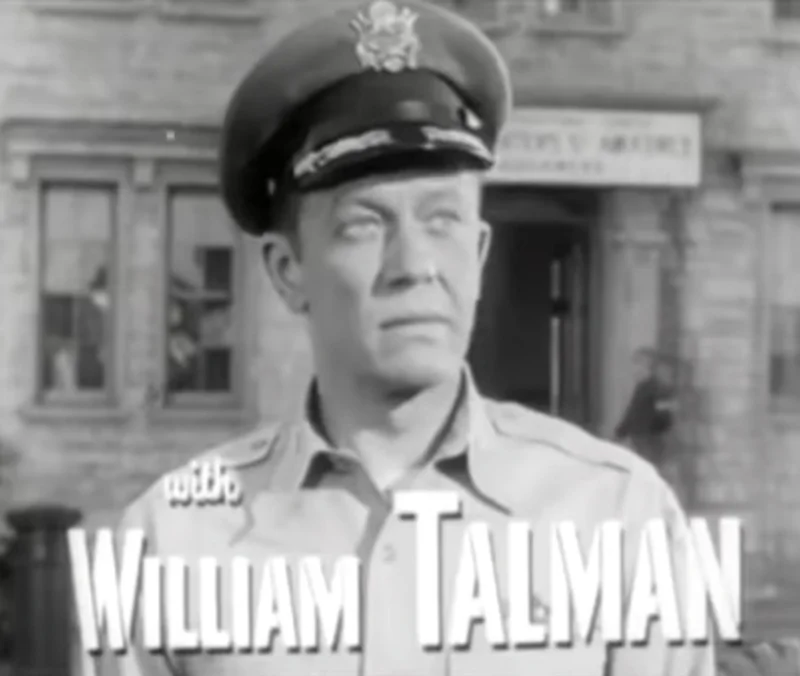
Photo: Trailer screenshot, via Wikimedia Commons. William Talman in the trailer for One Minute to Zero (released 1952). Existing crop resized; share image adapted. Public domain in the United States (no notice). Portrait resized and converted; share image cropped with text added. See the source and license details below. Image credits
Intro
William Talman (1915–1968) gave television one of its most familiar courtroom opponents as Hamilton Burger on Perry Mason. His career also reached Broadway and the darker corners of postwar crime films. Seen together, those performances offer a striking contrast: the district attorney arguing within a system of rules, and the gunman in The Hitch-Hiker trying to impose his own rules on everyone around him. This profile follows that range through selected stage credits, screen roles and documented photographs, with the original Perry Mason series as the entry point.
Career snapshot
Born in Detroit on February 4, 1915, Talman had established Broadway credits well before his television fame. The Broadway League’s database lists him as Ted Farlow in Beverly Hills in 1940, Arnold Greaves in Spring Again in 1941, and Harold Greenley in the 1947 revival of A Young Man’s Fancy. Those records place his career within a working theatre tradition, rather than beginning it with a single famous screen role. They also give a useful early timeline for viewers who know him principally from repeated television broadcasts.
The entry point
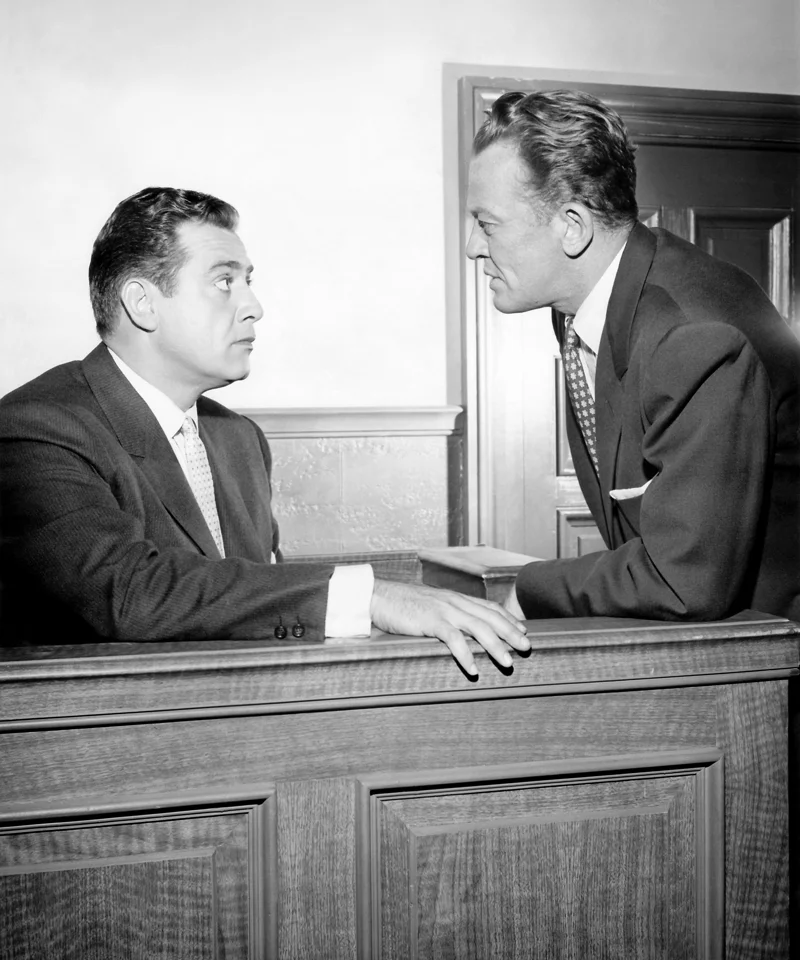
Perry Mason ran from 1957 to 1966, with Talman playing Los Angeles district attorney Hamilton Burger opposite Raymond Burr’s defense attorney. Burger usually occupies the losing side of the programme’s courtroom reversals, but the part depends on more than showing frustration. Watch how the prosecutor presents a case, responds to new testimony and maintains a formal bearing when certainty begins to slip. The gallery’s 1958 CBS publicity photograph pairs Talman with Burr for The Case of the Sun-Bather’s Diary; it records the original series, not a later adaptation.
Screen identity and style
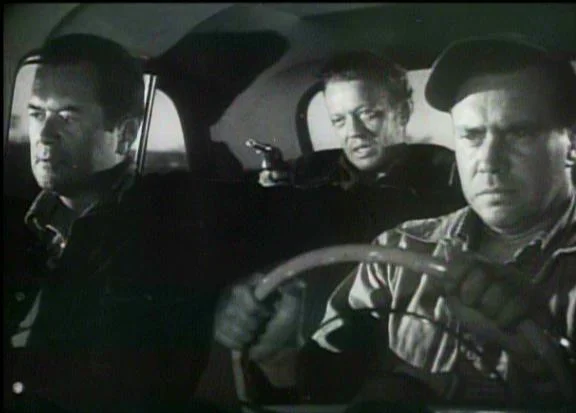
The Hitch-Hiker offers a much harsher use of Talman’s presence. AFI identifies his character as Emmett Myers, the armed stranger who takes two men hostage during their trip into Mexico. Edmond O’Brien plays Roy Collins and Frank Lovejoy plays Gilbert Bowen. A useful rewatch focuses on the unequal exchanges between the three men: who can ask a question, who must explain himself, and who controls the next stop. That concentrated conflict makes the film a strong companion to a Perry Mason episode, where Talman’s character must operate inside courtroom procedure.
Collaborations and patterns
Ida Lupino directed The Hitch-Hiker, with a screenplay credited by AFI to Lupino and Collier Young and adaptation work by Robert Joseph. Nicholas Musuraca photographed the film. TCM’s production account draws attention to the importance of Musuraca’s noir experience and Talman’s tense performance. For viewers, the collaboration is visible in how faces, confined space and barren surroundings make the threat legible. Talman’s work should be watched as part of that ensemble and visual design: the menace gains force from the reactions of O’Brien and Lovejoy as well as from the gunman himself.
Era reflection
Talman’s later public image extended beyond fictional crime. Historian Barron H. Lerner’s account describes his heavy smoking, a lung-cancer diagnosis in 1967 and the personal circumstances behind his final public-health message. Talman filmed an antismoking announcement for the American Cancer Society before his death in 1968. That appearance is a distinct part of his legacy: a performer recognizable from a long-running series addressing viewers about his own life. It belongs alongside the acting record, without turning an entertainment biography into individual medical advice or attributing his screen characters’ behavior to the actor.
Legacy and rediscovery
Begin with a Perry Mason courtroom exchange, then compare it with the hostage drama of The Hitch-Hiker. The portrait provides a third visual reference, drawn from the trailer for One Minute to Zero rather than from either better-known role. For a wider film exploration, Talman’s credits also include Armored Car Robbery and the late-career western The Ballad of Josie. His death on August 30, 1968, ended a career that moved between stage performance, feature films and episodic television. The surviving work rewards attention to supporting players whose authority and resistance give a leading character someone substantial to confront.
A career in pictures
Selected career milestones. Years identify the production or labeled milestone; recurring actors may join a series later. Artwork represents the production and may show other cast members. Select an image for a larger view.

One Minute to Zero
Film cast member; trailer portrait. Trailer image identifies Talman in this production.
Trailer screenshot; public domain in the U.S. (no notice). Resized locally. Image credits
The Hitch-Hiker
Emmett Myers. Frank Lovejoy, William Talman and Edmond O’Brien in a scene from the original film.
Film screenshot; public domain in the U.S. (copyright not renewed), per Commons. Resized locally. Image credits
Perry Mason
Hamilton Burger, opposite Raymond Burr. CBS publicity photograph for The Case of the Sun-Bather’s Diary; series began in 1957.
CBS Television, photographer unknown; public domain in the U.S. (no notice). Resized locally. Image credits
Rewatch notes
- Talman’s Broadway credits begin with Beverly Hills in 1940.
- AFI credits him as Emmett Myers in Ida Lupino’s The Hitch-Hiker.
- The gallery’s Perry Mason photograph is a dated CBS publicity image from 1958.
Career highlights
Trailer image identifies Talman in this production.
Frank Lovejoy, William Talman and Edmond O’Brien in a scene from the original film.
CBS publicity photograph for The Case of the Sun-Bather’s Diary; series began in 1957.
Sources and image credits
Portrait: Trailer screenshot, via Wikimedia Commons
https://commons.wikimedia.org/wiki/File:William_Talman_in_One_Minute_to_Zero_trailer.jpg
License: Public domain in the United States (no notice) https://commons.wikimedia.org/wiki/Template:PD-US-no_notice
- One Minute to Zero — Trailer screenshot; public domain in the U.S. (no notice). Resized locally.
https://commons.wikimedia.org/wiki/File:William_Talman_in_One_Minute_to_Zero_trailer.jpg - The Hitch-Hiker — Film screenshot; public domain in the U.S. (copyright not renewed), per Commons. Resized locally.
https://commons.wikimedia.org/wiki/File:Hitchhiker1953.JPG - Perry Mason — CBS Television, photographer unknown; public domain in the U.S. (no notice). Resized locally.
https://commons.wikimedia.org/wiki/File:Perry-Mason-Burr-Talman-1958.jpg
Reviewed September 29, 2026. Source references and image credits are listed below. This is a selected profile, not a complete credit list.
- Internet Broadway Database: William Talman
https://www.ibdb.com/broadway-cast-staff/william-talman-105419 - AFI Catalog: The Hitch-Hiker (1953)
https://catalog.afi.com/Film/50872-THE-HITCH-HIKER - William Talman career overview and referenced television history
https://en.wikipedia.org/wiki/William_Talman_(actor) - Barron H. Lerner: Remembering the Man Who Always Lost to Perry Mason (2002)
https://www.historynewsnetwork.org/article/medical-remembering-the-man-who-always-lost-to-per - TCM: The Hitch-Hiker, production context
https://www.tcm.com/articles/78324/the-hitch-hiker - Image provenance: William_Talman_in_One_Minute_to_Zero_trailer.jpg
https://commons.wikimedia.org/wiki/File:William_Talman_in_One_Minute_to_Zero_trailer.jpg - Image provenance: Hitchhiker1953.JPG
https://commons.wikimedia.org/wiki/File:Hitchhiker1953.JPG - Image provenance: Perry-Mason-Burr-Talman-1958.jpg
https://commons.wikimedia.org/wiki/File:Perry-Mason-Burr-Talman-1958.jpg
Production artwork is reused from the DailyTimeCapsule archive. The imagery represents the production and may not depict this actor or their particular season. Portrait and share-photo attribution appears beneath the portrait.
Corrections: hello@dailytimecapsule.com