
Dress Parade (1927)
William Boyd and Bessie Love in publicity
Period lobby card, not a modern production photograph.
Entry point: Hop-Along Cassidy (1935).
Explore the career in pictures
Updated
William Boyd was an American actor and producer whose screen identity became closely associated with Hopalong Cassidy. Born in Hendrysburg, Ohio, in 1895, he moved through silent-film stardom before finding the Western character that would define his later career. The National Cowboy & Western Heritage Museum places his work in both performance history and the business of television and merchandise. This page follows the actor who played Hoppy, rather than William 'Stage' Boyd or the later novelist of the same name. Boyd died in 1972, leaving a career that spans several very different eras of entertainment.
Before the black hat and white horse, Boyd appeared in the silent cinema associated with Cecil B. DeMille. The Hollywood Walk of Fame biography identifies The Volga Boatman among his early leading work. The 1925 portrait in the Sayre Collection preserves the appearance of that younger performer. A Dress Parade lobby card from 1927, featuring Boyd and Bessie Love, offers another contemporary record. These materials make it easier to see him as a leading man with an established career before the Western series, rather than imagining that his screen life began with Cassidy.
Hop-Along Cassidy in 1935 became the decisive new beginning. The Walk of Fame account records that Boyd was initially offered Red Connors and sought the title role instead. The screen interpretation softened the rougher figure in Clarence E. Mulford's fiction into an unusually dependable hero. For a first viewing, watch how the character establishes trust before the action begins: the appeal depends on judgment and restraint as well as a confrontation's outcome. That steadiness helps explain why a recurring character could remain recognizable across many separate adventures without requiring a single continuous story.
The official Hopalong history describes a hero dressed in black, paired with the white horse Topper and accompanied by younger and older companions. The costume works as an immediate visual signature, while the companions allow trouble and comedy to develop around a relatively composed central figure. A useful viewing exercise is to follow who initiates a scene's confusion and who resolves it. Boyd's character often supplies the stable point within that arrangement. His work belongs to a popular serial tradition in which familiarity is part of the pleasure, and changes in setting renew an established relationship with the audience.
Two Arabian Knights shows a different partnership. AFI identifies Boyd, Louis Wolheim and Mary Astor in Lewis Milestone's 1927 comedy, produced with Howard Hughes's backing. Its combination of soldiers, escape and romantic adventure places Boyd within ensemble comedy before the Cassidy years. The Academy's record confirms Milestone's directing award in the comedy category at the first Oscars; this was recognition for the director, not an acting award for Boyd. The lobby card retained here is publicity for that specific film. It can be compared with Dress Parade's presentation of Boyd to see how distributors sold a leading actor across different stories.
Boyd's later importance extends beyond acting in the original films. The National Cowboy Museum describes his acquisition of rights and the renewed audience created when existing Cassidy pictures moved onto television. That history makes the career a useful example of older films finding a second commercial life in a new medium. Smithsonian holdings add a material trace of the character's reach: a Capitol recording of Hopalong Cassidy and the Square Dance Holdup credits Boyd as recording artist. The Forest Service's 1950 photograph, showing him with Chris Granger, likewise records the recognizable cowboy figure outside a dramatic film scene.
A balanced introduction pairs one Cassidy adventure with an earlier silent picture such as Two Arabian Knights. Look for the difference between a star sharing a comic situation and a performer carrying a long-established hero's identity. The museum inducted Boyd into its Hall of Great Western Performers in 1995, reflecting the lasting place of the Western work in his reputation. The gallery keeps two silent-era publicity pieces alongside the later Forest Service photograph so that the familiar Hoppy image does not erase what came before. Each item is identified as publicity or an archival photograph, with local images and separate source credits.
Silent-film lobby cards and a later Forest Service photograph trace Boyd's career before and during his Hopalong Cassidy fame. Select an image for a larger view.
William Boyd and Bessie Love in publicity
Period lobby card, not a modern production photograph.
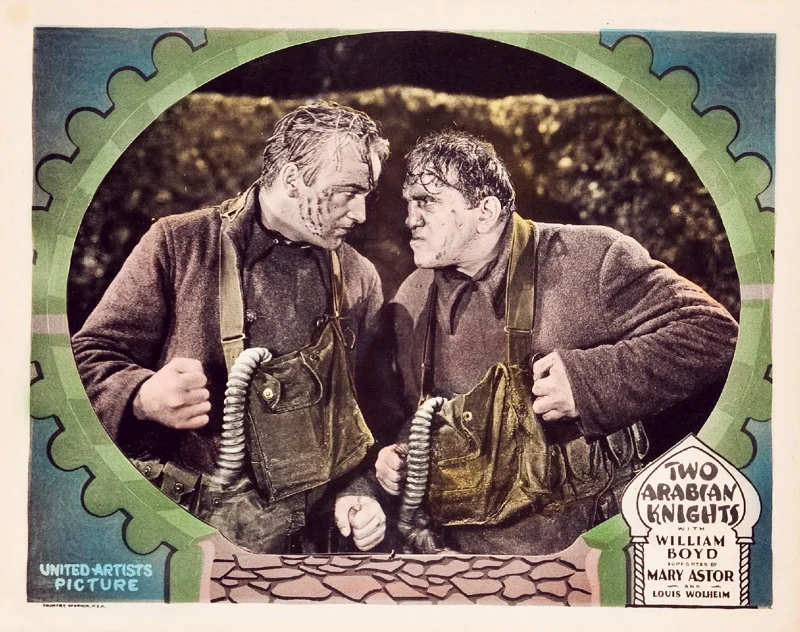
William Boyd in film publicity
United Artists lobby card for the Lewis Milestone film.
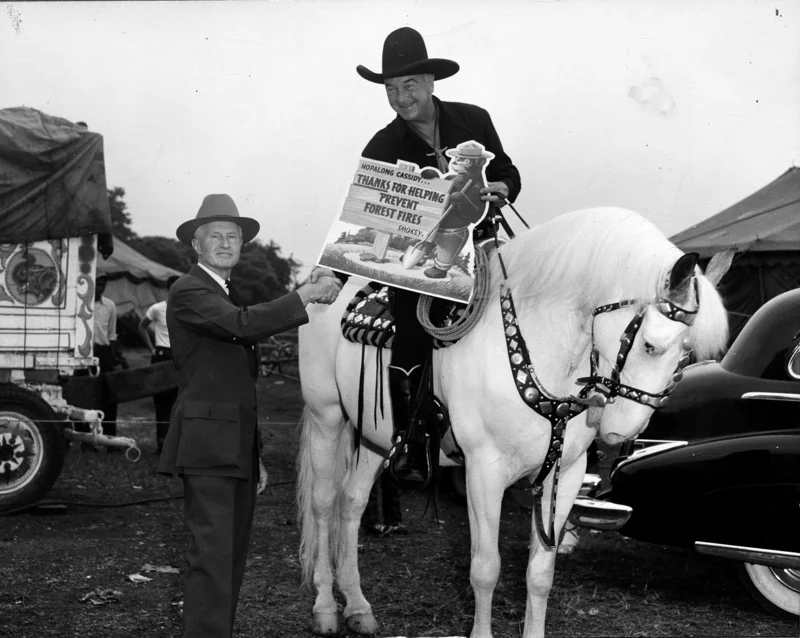
William Boyd in a Forest Service photograph
Archival public appearance photograph; not a film scene.
National Cowboy Museum: William Boyd
https://nationalcowboymuseum.org/blog/this-week-in-the-west-episode-97-william-boyd-and-the-cowboy-brand-of-hopalong-cassidy/
Hollywood Walk of Fame: William Boyd
https://walkoffame.com/william-boyd/
Hopalong Cassidy: character history
https://hopalongcassidy.com/hoppy-history/
AFI Catalog: Two Arabian Knights
https://catalog.afi.com/Film/12895-TWO-ARABIAN-KNIGHTS
Academy: first Academy Awards
https://www.oscars.org/oscars/ceremonies/1929
Smithsonian: Hopalong Cassidy recording
https://americanhistory.si.edu/collections/object/nmah_1213391
Commons: portrait provenance and license
https://commons.wikimedia.org/wiki/File:Actor_William_Boyd_%28SAYRE_10000%29.jpg
Corrections: hello@dailytimecapsule.com
Work: Actor_William_Boyd_(SAYRE_10000).jpg
Creator: Unidentified photographer; University of Washington, J. Willis Sayre Collection
Date: 1925
Original source: https://commons.wikimedia.org/wiki/File:Actor_William_Boyd_%28SAYRE_10000%29.jpg
Primary archive: https://commons.wikimedia.org/wiki/File:Actor_William_Boyd_%28SAYRE_10000%29.jpg
License: Public domain in the United States: expired publication term
License URI: https://commons.wikimedia.org/wiki/File:Actor_William_Boyd_(SAYRE_10000).jpg
Changes: Resized and converted to WebP; share image adds framing and title.
Rights scope: No endorsement implied. See the stated license and modification notice.
Work: Dress_Parade_lobby_card.jpg
Creator: Pathé Exchange
Date: 1927
Original source: https://commons.wikimedia.org/wiki/File:Dress_Parade_lobby_card.jpg
Primary archive: https://commons.wikimedia.org/wiki/File:Dress_Parade_lobby_card.jpg
License: Public domain in the United States: expired publication term
License URI: https://commons.wikimedia.org/wiki/File:Dress_Parade_lobby_card.jpg
Changes: Resized and converted to WebP.
Rights scope: No endorsement implied. See the stated license and modification notice.
Work: Two_Arabian_Knights_lobby_card.jpg
Creator: United Artists
Date: 1927
Original source: https://commons.wikimedia.org/wiki/File:Two_Arabian_Knights_lobby_card.jpg
Primary archive: https://commons.wikimedia.org/wiki/File:Two_Arabian_Knights_lobby_card.jpg
License: Public domain in the United States: expired publication term
License URI: https://commons.wikimedia.org/wiki/File:Two_Arabian_Knights_lobby_card.jpg
Changes: Resized and converted to WebP.
Rights scope: No endorsement implied. See the stated license and modification notice.
Work: 1950XXXX-FS-00073_(50223177111).png
Creator: Forest Service Photography
Date: 1950
Original source: https://commons.wikimedia.org/wiki/File:1950XXXX-FS-00073_%2850223177111%29.png
Primary archive: https://commons.wikimedia.org/wiki/File:1950XXXX-FS-00073_%2850223177111%29.png
License: Public Domain Mark; Forest Service archival photograph
License URI: https://creativecommons.org/publicdomain/mark/1.0/
Changes: Resized and converted to WebP.
Rights scope: No endorsement implied. See the stated license and modification notice.