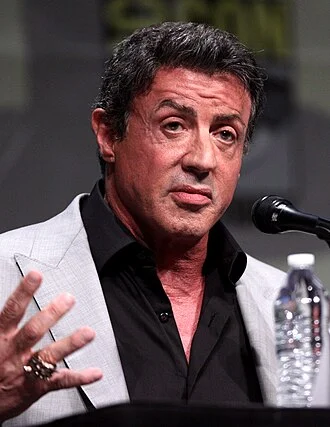
Comic-Con appearance (2012)
The Expendables 2 panel
Gage Skidmore photograph dated July 12, 2012, at San Diego Comic-Con.
Entry point: Rocky (1976).
Explore the career in pictures
Updated
Sylvester Stallone is an American actor, screenwriter and director whose career is closely associated with Rocky Balboa and John Rambo. Those characters belong to different kinds of film: Rocky began as a drama about a Philadelphia boxer, while First Blood introduced a Vietnam veteran confronted by a small-town sheriff. Stallone's authorship is an important part of the story. He wrote Rocky and later directed several films in that series, combining a leading performance with responsibility for how the character developed across successive productions.
Born in New York City, Stallone studied drama at the University of Miami before pursuing acting work in New York. His official biography describes writing screenplays while seeking roles, and identifies The Lords of Flatbush in 1974 as an early substantial opportunity. He also contributed additional dialogue to that film. The move to Hollywood did not immediately produce stardom, but the screenplay for Rocky gave him a project in which he was determined to play the lead. The resulting film was released in 1976, directed by John G. Avildsen.
At the Academy Awards ceremony held in March 1977, Rocky won Best Picture, and Stallone received nominations for leading actor and original screenplay. The distinction is useful: the film's Best Picture award should not be described as a personal acting Oscar. Rocky's supporting ensemble included Talia Shire, Burt Young and Burgess Meredith, all nominated for their performances that year. Stallone returned to the character in subsequent films and directed Rocky II, Rocky III and Rocky IV, before revisiting an older Balboa in the 2006 film Rocky Balboa.
First Blood arrived in 1982, with Stallone as John Rambo, Brian Dennehy as Sheriff Will Teasle and Richard Crenna as Colonel Samuel Trautman. The veteran's confrontation with local authority became the starting point for another continuing screen identity. Stallone also pursued roles outside those two series, including John Spartan in Demolition Man and Sheriff Freddy Heflin in Cop Land. The latter, released in 1997, placed him in a crime drama rather than another boxing or military adventure. These parts broaden a filmography often remembered chiefly through its two most familiar names.
The Expendables brought Stallone's acting and filmmaking work together again in 2010. He wrote, directed and starred in the ensemble action film, whose performers included Jason Statham, Jet Li and Dolph Lundgren. At a Cannes conversation in 2019, Stallone connected that project with the subject of aging: the attraction was to gather established action performers whose years could be part of the film's appeal. In the same conversation he discussed Rocky Balboa as a story about accepting age. Both comments offer his own account of recurring concerns in his later work.
Creed returned Stallone to Rocky in a supporting role alongside a new central boxer. His performance earned a supporting-actor nomination at the 2016 Academy Awards, his third Oscar nomination overall. Looking back at Cannes, he explained that he had initially been reluctant to revisit the character but was persuaded by director Ryan Coogler's enthusiasm. This was a different dramatic position from the original Rocky: Balboa could now be a mentor within another person's story. Stallone also appeared in Creed II, extending that later phase of the character's screen life.
Television supplied another sustained leading role with Tulsa King, which began in 2022. Stallone plays Dwight Manfredi, a New York mob figure sent to Oklahoma after a long prison sentence, where he starts building a new operation. The series adds a criminal character and a serialized format to a career dominated by feature films. The accompanying photographs span three separate public contexts: Alan Light's 1984 Hawaii photograph, Gage Skidmore's 2012 Comic-Con portrait and Georges Biard's 2019 Cannes image. Together they document different periods of the performer rather than staged scenes of Rocky, Rambo or Dwight.
Three distinct photographs from 1984, 2012 and 2019 show Stallone across public appearances, with individual source and license credits.
The Expendables 2 panel
Gage Skidmore photograph dated July 12, 2012, at San Diego Comic-Con.
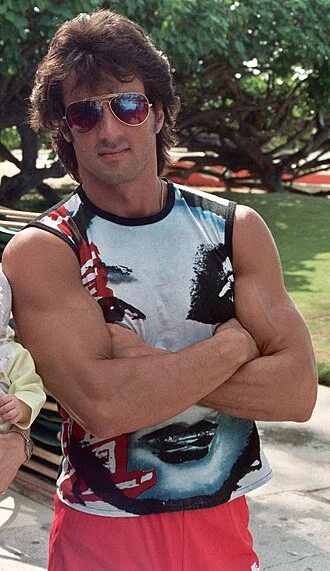
Public photograph
Photo by Alan Light, dated May 1984 in Hawaii.
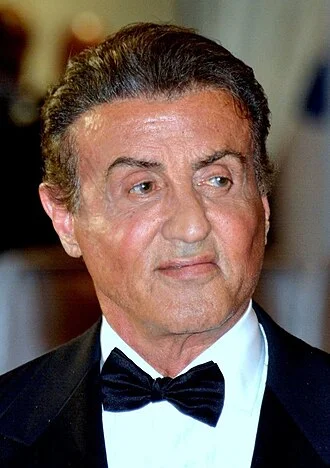
Film festival
Georges Biard photograph from the Cannes Film Festival in May 2019.
Official career biography
https://sylvesterstallone.com/bio/
1977 Academy Awards
https://www.oscars.org/oscars/ceremonies/1977
First Blood production record
https://sylvesterstallone.com/film-tv/first-blood/
Career filmography
https://en.wikipedia.org/wiki/Sylvester_Stallone_filmography
Cannes career conversation
https://www.festival-cannes.com/en/2019/rendez-vous-with-sylvester-stallone/
Creed nomination record
https://www.oscars.org/sites/oscars/files/88th-factsheet.pdf
Tulsa King character synopsis
https://www.paramountpressexpress.com/paramount-plus/shows/tulsa-king/
Commons: portrait provenance and license
https://commons.wikimedia.org/wiki/File:Sylvester%20Stallone%20by%20Gage%20Skidmore%202.jpg
Corrections: hello@dailytimecapsule.com
Work: Sylvester Stallone by Gage Skidmore 2.jpg
Creator: Gage Skidmore
Date: 2012-07-12
Original source: https://commons.wikimedia.org/wiki/File:Sylvester%20Stallone%20by%20Gage%20Skidmore%202.jpg
Primary archive: https://commons.wikimedia.org/wiki/File:Sylvester%20Stallone%20by%20Gage%20Skidmore%202.jpg
License: CC BY-SA 3.0
License URI: https://creativecommons.org/licenses/by-sa/3.0
Changes: Resized and converted to WebP; portrait also placed in a titled share image. No endorsement implied. These image derivatives remain available under CC BY-SA 3.0.
Rights scope: No endorsement implied. See the stated license and modification notice.
Work: Sylvester Stallone (1984).jpg
Creator: photo by Alan Light
Date: 1984-05
Original source: https://commons.wikimedia.org/wiki/File:Sylvester%20Stallone%20%281984%29.jpg
Primary archive: https://commons.wikimedia.org/wiki/File:Sylvester%20Stallone%20%281984%29.jpg
License: CC BY 2.0
License URI: https://creativecommons.org/licenses/by/2.0
Changes: Resized and converted to WebP; portrait also placed in a titled share image. No endorsement implied.
Rights scope: No endorsement implied. See the stated license and modification notice.
Work: Sylvester Stallone Cannes 2019.jpg
Creator: Georges Biard
Date: 2019-05
Original source: https://commons.wikimedia.org/wiki/File:Sylvester%20Stallone%20Cannes%202019.jpg
Primary archive: https://commons.wikimedia.org/wiki/File:Sylvester%20Stallone%20Cannes%202019.jpg
License: CC BY-SA 3.0
License URI: https://creativecommons.org/licenses/by-sa/3.0
Changes: Resized and converted to WebP; portrait also placed in a titled share image. No endorsement implied. These image derivatives remain available under CC BY-SA 3.0.
Rights scope: No endorsement implied. See the stated license and modification notice.