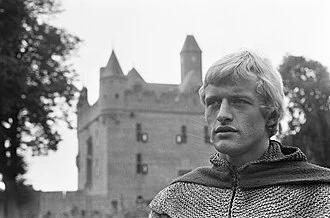
Floris production at Doornenburg (1968)
Floris van Rosemondt
Rutger Hauer in costume at Doornenburg on September 19, 1968, before the 1969 broadcast; Eric Koch / Anefo, Nationaal Archief.
Entry point: Floris (1969).
Explore the career in pictures
Updated
Rutger Hauer was a Dutch actor whose international career encompassed adventure, romantic drama, science fiction, horror and television. Roy Batty in Blade Runner became his most enduring screen identity, but that performance followed substantial work in the Netherlands and was only one part of a career that continued for decades. His early association with Paul Verhoeven helped establish him in Dutch popular culture before English-language films introduced him to a wider audience. The photographs here span that progression, from the production of Floris to a late-career convention appearance.
Born in 1944, Hauer grew up with parents who were actors. Before his screen career developed, he studied acting and worked with the Noorder Compagnie, a touring company that brought theatre to communities around the Netherlands. Strand Releasing's biographical press material also records his work as a translator, costume designer and director of one-act plays. These experiences involved more than performing a finished script: they placed him within the practical work of making theatre. His eventual film career retained that interest in shaping a character rather than simply presenting an imposing physical presence.
The television adventure Floris, broadcast in 1969, placed Hauer in its leading role and began an important collaboration with director Paul Verhoeven and writer Gerard Soeteman. Verhoeven later directed him opposite Monique van de Ven in Turkish Delight, released in 1973. Eye Filmmuseum places that film within the expansion of Dutch feature filmmaking and records its large domestic audience and Oscar nomination. The productions belong to different forms of entertainment, one a television adventure and the other an adult romantic drama, yet both were central to Hauer's emergence as a Dutch star.
Blade Runner cast Hauer as Roy Batty, a replicant confronting the limits placed on his life. The performance's final speech became inseparable from the film's reputation, and the BFI records Hauer's contribution to its wording. His work elsewhere could be much more threatening, particularly in The Hitcher, or more openly romantic, as in Ladyhawke. That range matters when looking back at his career: the familiar intensity did not always serve the same dramatic purpose. It could support menace, vulnerability or the emotional urgency of a character who seemed at first to be an adversary.
Television brought major recognition through Escape from Sobibor, the 1987 drama about prisoners organizing an escape from a Nazi death camp. Hauer's supporting performance won a Golden Globe at the 1988 awards. The distinction between the film's year and the ceremony's year is worth retaining when tracing that credit. His later television work included Fatherland, alongside appearances in series such as Alias, Smallville and True Blood. These assignments extended his career beyond the films most often associated with him, allowing him to enter new ensembles and different kinds of serialized storytelling.
Hauer continued working across contrasting productions as he grew older. Films such as Batman Begins and Sin City placed him within large contemporary ensembles, while smaller projects offered different kinds of central roles. In a 2018 interview about Samson, he discussed approaching the father of the title character and looking beyond a purely stern parental function. Away from acting, he founded the Rutger Hauer Starfish Association, devoted to HIV/AIDS awareness and related support. His autobiography, All Those Moments, also became part of the public record of a life spent moving among countries, genres and productions.
Hauer died in 2019, leaving a body of work that invites viewing beyond the single role most frequently recalled. The BFI's retrospective included The Legend of the Holy Drinker and Blind Fury alongside Blade Runner, illustrating how differently filmmakers used his presence. The gallery preserves that sense of time without pretending to show a scene from every major film. Eric Koch's 1968 archival photograph shows him in costume during Floris production at Doornenburg; the 2018 image is a convention video still. Their dates refer to the recorded appearances, not to the later release dates of unrelated works.
An archival Floris production photograph and a distinct late-career convention video still.
Floris van Rosemondt
Rutger Hauer in costume at Doornenburg on September 19, 1968, before the 1969 broadcast; Eric Koch / Anefo, Nationaal Archief.
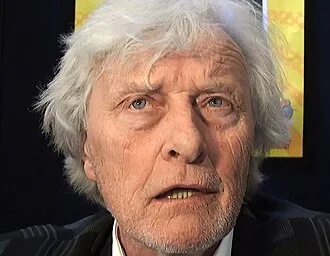
Convention appearance
Still from German Film & Comic Con's video of the May 5-6, 2018 Frankfurt event; the source video was uploaded May 9, 2018.
Golden Globes: remembering Rutger Hauer
https://goldenglobes.com/articles/remembering-rutger-hauer-golden-globe-winner/
Golden Globes: Escape from Sobibor
https://goldenglobes.com/tv-show/escape-from-sobibor/
BFI: five performances
https://www.bfi.org.uk/lists/rutger-hauer-5-great-performances
Eye: Turkish Delight and Dutch cinema
https://www.eyefilm.nl/en/collection/collections/film/film-files/de-jaren-zestig-en-zeventig/turks-fruit-en-het-succes-van-de-nederlandse-speelfilm
Eye: Gerard Soeteman and Floris
https://filmdatabase.eyefilm.nl/collectie/filmgeschiedenis/persoon/gerard-soeteman
RogerEbert.com: Samson interview
https://www.rogerebert.com/interviews/a-universal-story-rutger-hauer-on-samson
RogerEbert.com: retrospective
https://www.rogerebert.com/features/mysterious-traveller-rutger-hauer-1944-2019
SYFY: Rutger Hauer biography
https://www.syfy.com/people/rutger-hauer
Strand Releasing: Il Futuro press kit
https://strandreleasing.com/wp-content/uploads/2014/12/Il-Futuro_pk.pdf
Commons: portrait provenance and license
https://commons.wikimedia.org/wiki/File:De%20titelrol%20Floris%20van%20Rosemondt%20wordt%20gespeeld%20door%20Rutger%20Hauer%2C%20Bestanddeelnr%20921-6924.jpg
Corrections: hello@dailytimecapsule.com
Work: De titelrol Floris van Rosemondt wordt gespeeld door Rutger Hauer, Bestanddeelnr 921-6924.jpg
Creator: Eric Koch for Anefo
Date: 1968-09-19
Original source: https://commons.wikimedia.org/wiki/File:De%20titelrol%20Floris%20van%20Rosemondt%20wordt%20gespeeld%20door%20Rutger%20Hauer%2C%20Bestanddeelnr%20921-6924.jpg
Primary archive: https://commons.wikimedia.org/wiki/File:De%20titelrol%20Floris%20van%20Rosemondt%20wordt%20gespeeld%20door%20Rutger%20Hauer%2C%20Bestanddeelnr%20921-6924.jpg
License: CC0
License URI: http://creativecommons.org/publicdomain/zero/1.0/deed.en
Changes: Resized and converted to WebP; portrait also placed in a titled share image. No endorsement implied.
Rights scope: No endorsement implied. See the stated license and modification notice.
Work: Rutger Hauer German Comic Con 2018.jpg
Creator: German Film & Comic Con
Date: 2018-05-09
Original source: https://commons.wikimedia.org/wiki/File:Rutger%20Hauer%20German%20Comic%20Con%202018.jpg
Primary archive: https://commons.wikimedia.org/wiki/File:Rutger%20Hauer%20German%20Comic%20Con%202018.jpg
License: CC BY 3.0
License URI: https://creativecommons.org/licenses/by/3.0
Changes: Resized and converted to WebP; portrait also placed in a titled share image. No endorsement implied.
Rights scope: No endorsement implied. See the stated license and modification notice.