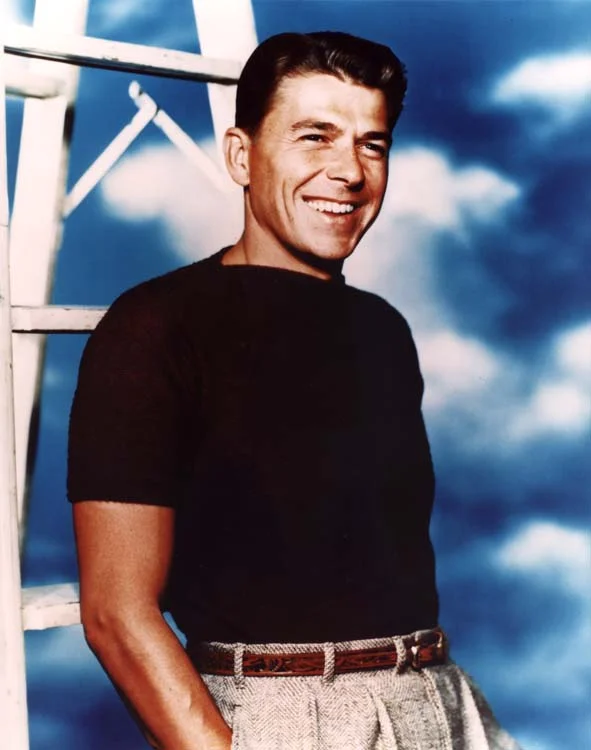
Photo: Unknown photographer; courtesy Ronald Reagan Library. Ronald Reagan in a 1940s publicity photograph, archive reference H107. Public domain (Ronald Reagan Library archive record). Portrait resized and converted; share image cropped with text added. See the source and license details below. Image credits
Intro
Ronald Reagan worked as a radio broadcaster, film actor and television host before becoming governor of California and president of the United States. Born in Tampico, Illinois, on February 6, 1911, he entered Hollywood in 1937 under contract to Warner Bros. This page follows his screen career: early studio assignments, the dramatic roles in Knute Rockne, All American and Kings Row, and the television work that brought him into viewers' homes. The 1940s portrait places him within that acting period rather than his later elected offices.
Career snapshot
Reagan graduated from Eureka College in 1932 and found work broadcasting sports in Iowa. While in California to cover the Chicago Cubs' spring training in 1937, he took a screen test that led to his Warner Bros. contract. Love Is on the Air gave him a leading role as a radio announcer, connecting his earlier experience to a fictional screen assignment. Brother Rat and Dark Victory followed among his early films. During World War II, his service included work with the Army Air Forces' First Motion Picture Unit, which produced training films.
The entry point
Kings Row, released in 1942, cast Reagan as Drake McHugh alongside Robert Cummings, Ann Sheridan and Betty Field. The drama explores lives and relationships within a small town, with Charles Coburn and Claude Rains also in the ensemble. Drake's experience includes a devastating medical intervention and its aftermath. The role asks Reagan to move from youthful confidence into vulnerability. For a rewatch, compare the character's early social ease with the later scenes involving Sheridan's Randy: the relationship makes the change legible through interaction as well as dialogue.
Screen identity and style
Knute Rockne, All American offers a different dramatic task. Reagan plays football player George Gipp opposite Pat O'Brien as the Notre Dame coach. The 1940 film helped establish an enduring association between Reagan and the nickname Gipper. It also provides a useful contrast with Kings Row: one part belongs to a sports biography built around a coach and his players, while the other sits within an ensemble melodrama. Neither role is a substitute for the historical person. They are performances shaped by scripts, editing and the expectations of studio filmmaking.
Collaborations and patterns
Reagan's later screen work ranged from comedy to crime drama. Bedtime for Bonzo appeared in 1951, and Hellcats of the Navy in 1957 paired him with Nancy Davis. In the 1964 version of The Killers, he played Jack Browning alongside Lee Marvin, Angie Dickinson and John Cassavetes. That film's criminal world offers a marked contrast to his more reassuring public-facing roles. The gallery distinguishes this adaptation from the earlier 1946 film of the same title, which did not feature him. Exact production years matter when following an actor through remakes and similarly named releases.
Era reflection
General Electric Theater made Reagan a recurring television host from 1954 through 1962; he also acted in episodes. As an anthology, the programme could present a different story and cast each week while retaining a familiar introduction. His work for General Electric also involved appearances at company facilities. Separately, Reagan served as Screen Actors Guild president in 1947-1952 and 1959-1960. Those terms spanned disputes over contracts, television residuals, strikes and the blacklist era. They place his career within the industry's working conditions as well as its films and programmes.
Legacy and rediscovery
Reagan's subsequent political career makes it easy to treat every screen appearance as preparation for what followed. Watching the productions in their own contexts offers a more useful career comparison. A sports announcer, a contract player in an ensemble and an anthology host perform different kinds of work. Start with Kings Row and Knute Rockne, then compare the television introductions and the later crime role. The selected gallery traces that change of format and tone, with production artwork separated from the credited personal portrait and sources retained for further identification.
A career in pictures
Selected career milestones. Years identify the production or labeled milestone; recurring actors may join a series later. Artwork represents the production and may show other cast members. Select an image for a larger view.
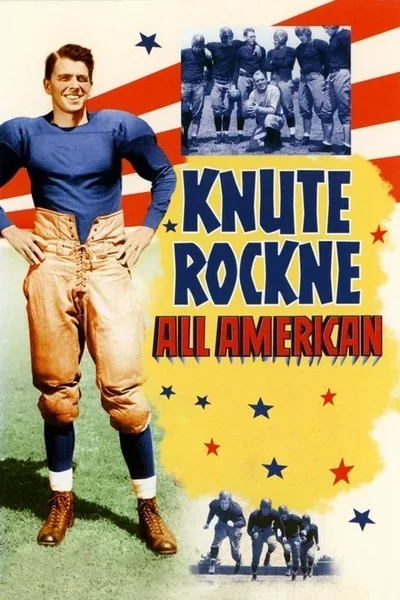
Knute Rockne, All American
George Gipp. The football biography starring Pat O'Brien as Knute Rockne.
Production artwork from the DailyTimeCapsule archive. Image credits
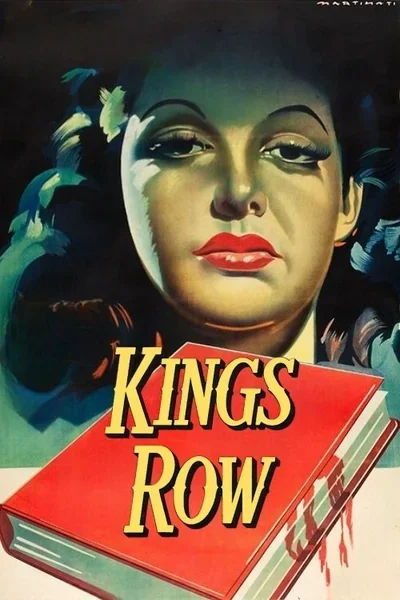
Kings Row
Drake McHugh. The ensemble drama released in 1942.
Production artwork from the DailyTimeCapsule archive. Image credits
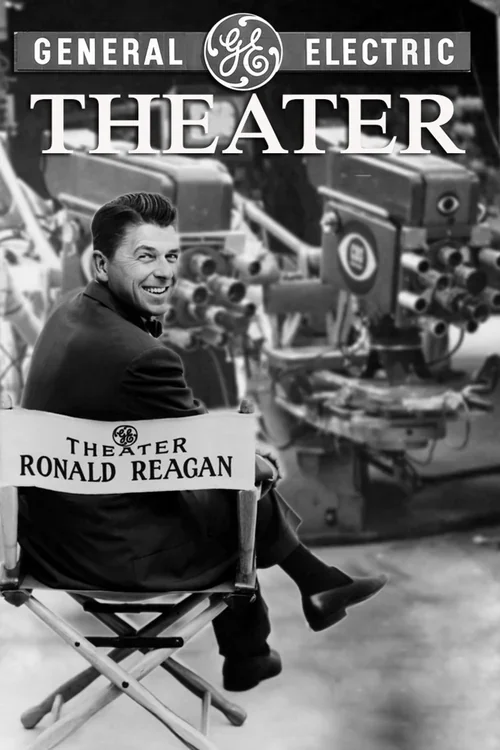
General Electric Theater
Host and occasional actor. Reagan became host in 1954; the series began in 1953.
Production artwork from the DailyTimeCapsule archive. Image credits
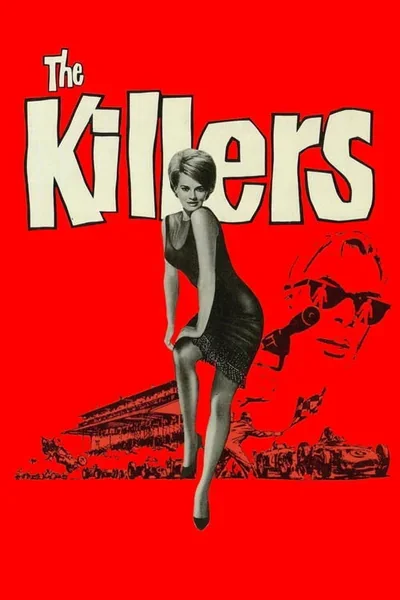
The Killers
Jack Browning. The 1964 adaptation, distinct from the 1946 film.
Production artwork from the DailyTimeCapsule archive. Image credits
Rewatch notes
- Reagan's first leading film role was a radio announcer in Love Is on the Air.
- He played George Gipp in Knute Rockne, All American.
- He hosted General Electric Theater from 1954 through 1962.
Career highlights
The football biography starring Pat O'Brien as Knute Rockne.
The ensemble drama released in 1942.
Reagan became host in 1954; the series began in 1953.
The 1964 adaptation, distinct from the 1946 film.
Sources and image credits
Portrait: Unknown photographer; courtesy Ronald Reagan Library
https://commons.wikimedia.org/wiki/File:Publicity_photograph_of_Ronald_Reagan_in_1940s.jpg
License: Public domain (Ronald Reagan Library archive record) https://commons.wikimedia.org/wiki/File:Publicity_photograph_of_Ronald_Reagan_in_1940s.jpg
- Knute Rockne, All American — Production artwork from the DailyTimeCapsule archive.
https://www.reaganlibrary.gov/reagans/ronald-reagan/ronald-reagans-filmography - Kings Row — Production artwork from the DailyTimeCapsule archive.
https://www.reaganlibrary.gov/reagans/ronald-reagan/ronald-reagans-filmography - General Electric Theater — Production artwork from the DailyTimeCapsule archive.
https://interviews.televisionacademy.com/shows/general-electric-theater-the - The Killers — Production artwork from the DailyTimeCapsule archive.
https://www.reaganlibrary.gov/reagans/ronald-reagan/ronald-reagans-filmography
Reviewed September 23, 2026. Source references and image credits are listed below. This is a selected profile, not a complete credit list.
- Ronald Reagan Library: filmography
https://www.reaganlibrary.gov/reagans/ronald-reagan/ronald-reagans-filmography - Ronald Reagan Library: pre-presidential biography and timeline
https://www.reaganlibrary.gov/reagans/ronald-reagan/reagans-pre-presidential-biographical-sketch-timeline-1911-1980 - Ronald Reagan Library: broadcasting and screen career exhibit
https://www.reaganlibrary.gov/permanent-exhibits/evolution-great-communicator - SAG-AFTRA: Ronald Reagan's union presidency
https://www.sagaftra.org/ronald-reagan - Television Academy: General Electric Theater
https://interviews.televisionacademy.com/shows/general-electric-theater-the - 1940s publicity portrait provenance
https://commons.wikimedia.org/wiki/File:Publicity_photograph_of_Ronald_Reagan_in_1940s.jpg
Production artwork is reused from the DailyTimeCapsule archive. The imagery represents the production and may not depict this actor or their particular season. Portrait and share-photo attribution appears beneath the portrait.
Corrections: hello@dailytimecapsule.com