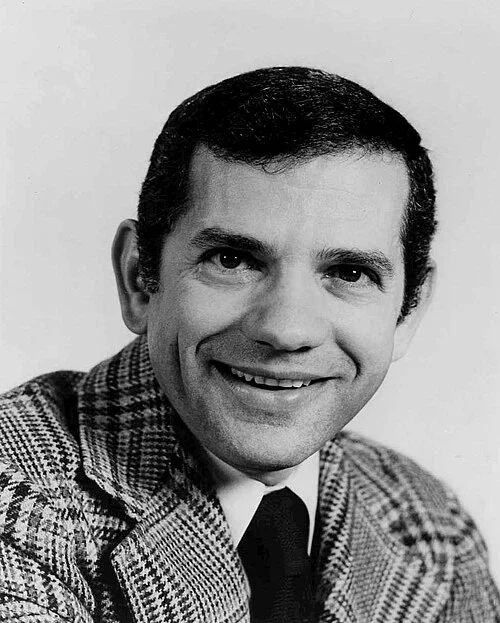
The Young and the Restless publicity (1973)
Robert Clary
Clary in publicity issued when he joined The Young and the Restless.
Entry point: Hogan's Heroes (1965).
Explore the career in pictures
Updated
Robert Clary was a French-born actor and singer best known to television audiences as Corporal LeBeau in Hogan's Heroes. His career included recording, theatre and daytime drama as well as comedy. He was also a Holocaust survivor who later devoted substantial time to preserving survivor testimony. Those parts of his life deserve to be understood distinctly: a fictional television role cannot stand in for the history he experienced or the testimony he chose to share.
Clary survived imprisonment in Nazi concentration camps and was liberated from Buchenwald in 1945. After the war he returned to performing, developed a recording career in France and eventually moved to the United States. His Television Academy oral history recalls Eddie Cantor's support and appearances in early television and New Faces of 1952. These experiences preceded the long association with Hogan's Heroes that brought him a broad television audience.
Hogan's Heroes ran from 1965 to 1971 and placed LeBeau within an ensemble of Allied prisoners operating against their captors. For a viewer exploring Clary's acting, the useful focus is his participation in the group's comic exchanges: how a response, an objection or an expression of confidence changes the timing of a scene. The character works within a recurring team, so individual moments gain meaning through the relationships around them.
Clary's background as a singer and live entertainer is an important part of his screen identity. Performance rhythm involves more than delivering a punch line; it also includes knowing when to listen, when to enter an exchange and how to share attention with another performer. His oral history discusses singing as well as acting. That wider background gives a viewer another way to approach a career often remembered through a single television character.
After Hogan's Heroes, Clary appeared in daytime dramas including The Young and the Restless, Days of Our Lives and The Bold and the Beautiful. These programs asked for a different relationship with continuing audiences than a half-hour comedy. Looking across those credits makes the career broader than one familiar uniform or setting. It also places his television work alongside the recording and stage performances he remembered in his later interviews.
USC Shoah Foundation records that Clary gave testimony in 1994 and then volunteered to interview other survivors, conducting 75 interviews over the following eighteen months. This work was a substantial commitment to remembrance. In his Television Academy interview he also addressed the difference between Hogan's Heroes and his own wartime experience. His testimony and memoir should be approached as historical and personal accounts, with their own purpose and context.
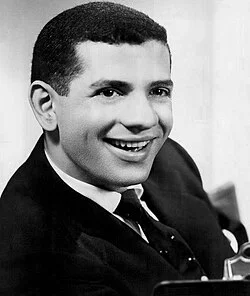
To explore the career, compare Clary's ensemble television work with his oral history and the record of his singing and stage appearances. He died in 2022. The gallery contains separate publicity portraits from 1973 and 1953, spanning different periods of his professional life. The later image was issued when he joined The Young and the Restless. Both records identify the issuing organization and document the basis for U.S. public-domain use.
Distinct photographs from 1973 and 1953 document different moments in the career, with individual credits below.
Robert Clary
Clary in publicity issued when he joined The Young and the Restless.
Robert Clary
Clary in a 1953 agency publicity portrait.
Television Academy oral history
https://interviews.televisionacademy.com/interviews/robert-clary
USC Shoah Foundation remembrance
https://sfi.usc.edu/news/2022/12/34551-hogans-heroes-actor-robert-clary-96-survived-holocaust
Autobiography publisher record
https://www.simonandschuster.com/books/From-the-Holocaust-to-Hogans-Heroes/Robert-Clary/9781461661931
Commons: portrait provenance and license
https://commons.wikimedia.org/wiki/File:Robert%20Clary%201973.jpg
Corrections: hello@dailytimecapsule.com
Work: Robert Clary 1973.jpg
Creator: Screen Gems
Date: 1973-05-27
Original source: https://commons.wikimedia.org/wiki/File:Robert%20Clary%201973.jpg
Primary archive: https://commons.wikimedia.org/wiki/File:Robert%20Clary%201973.jpg
License: Public domain in the United States (publication without copyright notice)
License URI: https://commons.wikimedia.org/wiki/File:Robert%20Clary%201973.jpg#Licensing
Changes: Resized and converted; share image adds text. Source crop retained where applicable.
Rights scope: Public-domain determination applies to the United States; other jurisdictions may differ. Publication-without-notice evidence is documented in the source archive. No endorsement implied.
Work: Robert Clary 1953.JPG
Creator: William Morris Agency
Date: 1953-09-25
Original source: https://commons.wikimedia.org/wiki/File:Robert%20Clary%201953.JPG
Primary archive: https://commons.wikimedia.org/wiki/File:Robert%20Clary%201953.JPG
License: Public domain in the United States (publication without copyright notice)
License URI: https://commons.wikimedia.org/wiki/File:Robert%20Clary%201953.JPG#Licensing
Changes: Resized and converted; share image adds text. Source crop retained where applicable.
Rights scope: Public-domain determination applies to the United States; other jurisdictions may differ. Publication-without-notice evidence is documented in the source archive. No endorsement implied.