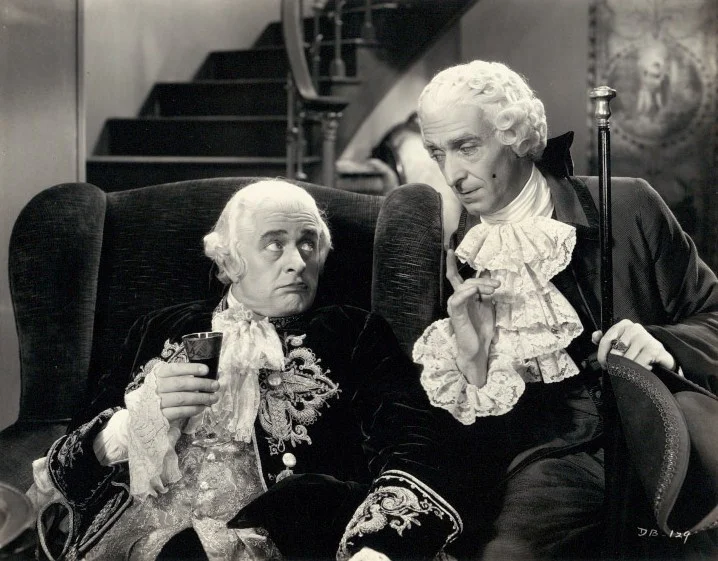
Madame Du Barry (1934)
Reginald Owen, left, with Osgood Perkins
Publicity photograph; not an image from A Christmas Carol.
Entry point: A Christmas Carol (1938).
Explore the career in pictures
Updated
Reginald Owen belongs to the long history of British stage performers who found a second professional home in Hollywood. Born in Wheathampstead, England, on August 5, 1887, he worked in theatre before becoming a familiar screen character actor. The contemporary International Television Almanac records London stage work, wartime service and an American appearance in The Swan in Chicago in 1924. His later screen career can be approached through two very different figures: Ebenezer Scrooge in MGM's A Christmas Carol and Admiral Boom in Disney's Mary Poppins. Neither alone describes the range of his working life.
The almanac places Owen's London stage debut in The Tempest in 1905 and lists productions including The Prisoner of Zenda, Pomander Walk and Our Betters. It also records service in the British Army from 1916 to 1919. Those details put the screen career in perspective: his experience did not begin at a Hollywood studio gate. The same professional record lists later films including Cluny Brown, The Secret Garden, Kim and The Miniver Story, as well as a New York stage engagement in Affairs of State in 1951–52. This is a selected route through a substantial career, rather than a claim to complete filmography.
A Christmas Carol is the clearest starting point for a focused viewing. AFI credits Owen as Ebenezer Scrooge in Edwin L. Marin's 1938 film, with Gene Lockhart as Bob Cratchit and Kathleen Lockhart as Mrs. Cratchit. Lionel Barrymore had originally been intended for Scrooge but could not undertake the production because of ill health; AFI records that he recommended Owen. The resulting film runs 69 minutes. Watch how the performance must make Scrooge's eventual change legible within that compact running time, moving from resistance toward the possibility of belonging to other people's lives.
Owen's work invites attention to the difference between a leading transformation and a supporting character's immediate impact. Scrooge has a whole narrative in which to change. A smaller part may need to establish a social position or comic attitude almost at once. Compare posture, the pace of a reply and the way a performer occupies the edge of an ensemble scene. These are viewing suggestions, not claims that every Owen character uses the same mannerisms. The gallery's separately dated publicity and trailer images offer visual reference points without pretending that a still photograph can reproduce the timing of a performance.
The Christmas Carol ensemble includes Terry Kilburn as Tiny Tim, Leo G. Carroll as Marley's ghost and Ann Rutherford as the Spirit of Christmas Past. Behind the camera, AFI identifies Hugo Butler's screenplay and Joseph L. Mankiewicz's production. The surrounding performances matter when revisiting Owen: Scrooge's isolation becomes meaningful through encounters with people whose lives continue beyond his concerns. A useful second viewing follows the supporting characters' reactions rather than only the central speeches. The film's visual storytelling, makeup and ensemble work should be considered alongside the star performance.
Disney's own reference identifies Owen's later roles as Admiral Boom in Mary Poppins and General Teagler in Bedknobs and Broomsticks. These appearances give viewers another path into his work, distinct from the black-and-white MGM films represented in the photographs below. They also caution against equating an actor's best-remembered part with the whole career. A family-film audience may encounter Owen through a brief, vivid character and only later discover his Scrooge. The connection is the performer, not a shared fictional world or a claim that the earlier gallery photographs belong to either Disney production.
Owen died in 1972, according to Disney's biographical entry. His surviving work rewards comparison across decades rather than a single definitive label. Begin with A Christmas Carol for a sustained central role, then revisit his Disney appearances for a different scale of performance. For the earlier studio years, use the dated gallery as a guide to productions worth investigating. The image acknowledgments distinguish trailer captures from publicity photography, retain the archive's rights information and identify the works actually shown. No image here is presented as a modern portrait or as evidence of a role in a different film.
Publicity and trailer photographs from 1934–1950 show distinct productions in Owen's career. They are not images from A Christmas Carol or his Disney films. Select an image for a larger view.
Reginald Owen, left, with Osgood Perkins
Publicity photograph; not an image from A Christmas Carol.
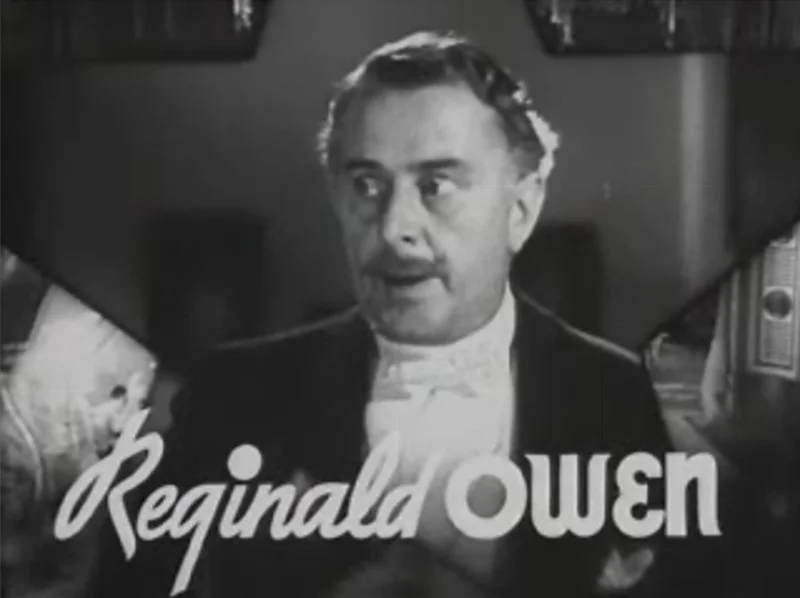
Reginald Owen in a trailer portrait
The same archival source supplies the page portrait.
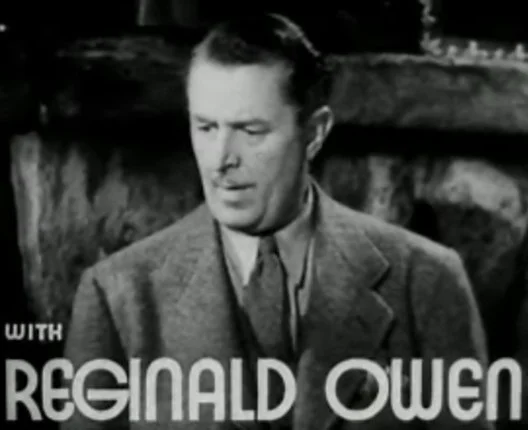
Reginald Owen in the film trailer
Cropped historical trailer image.
Reginald Owen in the film trailer
Small archival image; source resolution is 320 by 238 pixels.
AFI Catalog: A Christmas Carol
https://catalog.afi.com/Film/4054-A-CHRISTMAS-CAROL?cxt=filmography
Disney D23: Reginald Owen
https://d23.com/a-to-z/owen-reginald/
International Television Almanac 1959: professional biography
https://www.worldradiohistory.com/Archive-International-Television-Almanac/1959/International-Television-Almanac-1959-Whos-Who.pdf
Commons: portrait provenance and license
https://commons.wikimedia.org/wiki/File:Reginald_Owen_in_The_Great_Ziegfeld_trailer.jpg
Corrections: hello@dailytimecapsule.com
Work: Reginald_Owen_in_The_Great_Ziegfeld_trailer.jpg
Creator: MGM; trailer screenshot
Date: 1936
Original source: https://commons.wikimedia.org/wiki/File:Reginald_Owen_in_The_Great_Ziegfeld_trailer.jpg
Primary archive: https://commons.wikimedia.org/wiki/File:Reginald_Owen_in_The_Great_Ziegfeld_trailer.jpg
License: Public domain in the United States (no notice)
License URI: https://commons.wikimedia.org/wiki/Template:PD-US-no_notice
Changes: Archive crop; resized and converted to WebP. Portrait also placed in a titled share graphic.
Rights scope: No endorsement implied. See the stated license and modification notice.
Work: Madame_Du_Barry_(1934)_4.jpg
Creator: Warner Bros.; photographer unidentified
Date: 1934-10-15
Original source: https://commons.wikimedia.org/wiki/File:Madame_Du_Barry_%281934%29_4.jpg
Primary archive: https://commons.wikimedia.org/wiki/File:Madame_Du_Barry_%281934%29_4.jpg
License: Public domain in the United States (no notice)
License URI: https://commons.wikimedia.org/wiki/Template:PD-US-no_notice
Changes: Archive crop; resized and converted to WebP.
Rights scope: No endorsement implied. See the stated license and modification notice.
Work: Reginald_Owen_in_Petticoat_Fever_trailer.jpg
Creator: MGM; trailer screenshot
Date: 1936
Original source: https://commons.wikimedia.org/wiki/File:Reginald_Owen_in_Petticoat_Fever_trailer.jpg
Primary archive: https://commons.wikimedia.org/wiki/File:Reginald_Owen_in_Petticoat_Fever_trailer.jpg
License: Public domain in the United States (no notice)
License URI: https://commons.wikimedia.org/wiki/Template:PD-US-no_notice
Changes: Archive crop; converted to WebP.
Rights scope: No endorsement implied. See the stated license and modification notice.
Work: Reginald_Owen_in_The_Miniver_Story.JPG
Creator: MGM; trailer screenshot
Date: 1950
Original source: https://commons.wikimedia.org/wiki/File:Reginald_Owen_in_The_Miniver_Story.JPG
Primary archive: https://commons.wikimedia.org/wiki/File:Reginald_Owen_in_The_Miniver_Story.JPG
License: Public domain in the United States (no notice)
License URI: https://commons.wikimedia.org/wiki/Template:PD-US-no_notice
Changes: Archive crop; converted to WebP; small historical image retained at source resolution.
Rights scope: No endorsement implied. See the stated license and modification notice.