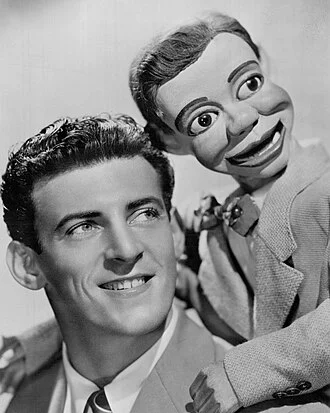
With Jerry Mahoney (1950)
Television publicity
NBC photograph whose earliest archive stamp is February 21, 1950.
Entry point: Winnie the Pooh and the Blustery Day (1968).
Explore the career in pictures
Updated
Paul Winchell was an American ventriloquist, actor, voice performer and inventor whose career connected the variety stage with early television and animation. On camera he shared the spotlight with Jerry Mahoney and Knucklehead Smiff, two puppet characters whose contrasting personalities turned a solo performer's act into lively conversation. Away from the camera, his voice became familiar through Tigger, Dick Dastardly and Gargamel. His work therefore reached audiences who could recognize the performer himself and others who knew only the animated characters he brought to life.
Born in New York City on December 21, 1922, Winchell began performing while still a teenager. The Television Academy records his first-prize appearance on Major Bowes' Original Amateur Hour in 1936, followed by live engagements and radio work. He admired Edgar Bergen's ventriloquism and developed his own act around a wooden companion rather than treating the puppet merely as a prop. Television widened the possibilities: viewers could see the apparently independent personality beside him, as well as the timing and physical reactions of the human half of the partnership.
The Smithsonian's collection preserves an early Jerry Mahoney figure, dated to around 1938 and sculpted by Frank Marshall. Its carved wooden head is detachable, and the museum describes the character's outspoken humor as a foil to Winchell's straight-man role. Jerry was not simply a different voice: songs, comic exchanges and quiz segments depended on the relationship between the two personalities. Knucklehead Smiff added another presence to the act. The survival of these figures offers a tangible record of performance techniques that otherwise depend on fleeting gestures and timing.
Winchell appeared with mind reader Joseph Dunninger on The Bigelow Show before gaining his own television showcase in 1950. The Paul Winchell and Jerry Mahoney Show combined comedy, music, quizzes and dramatic material, with guests including Peter Lorre and Margaret Truman. His later Winchell-Mahoney Time brought the partnership to children's television. He also performed without his familiar puppets in guest appearances on series including The Lucy Show, Perry Mason and The Brady Bunch. These assignments placed his comic and acting abilities in stories built around other performers.
Animation gave Winchell a different kind of ensemble. For Hanna-Barbera he voiced the scheming Dick Dastardly in Wacky Races and Dastardly and Muttley in Their Flying Machines, Fleegle in The Banana Splits Adventure Hour and the wizard Gargamel in The Smurfs. Disney cast him as Tigger in Winnie the Pooh and the Blustery Day in 1968, beginning a long association with the exuberant character. Other Disney work included Boomer in The Fox and the Hound. The roles ranged from villains to comic companions, making character contrast central to his recorded performances as well as his ventriloquism.
Invention was a parallel pursuit rather than a fictional attribute of his television characters. The Lemelson-MIT account describes his friendship with physician Henry Heimlich and his observations of surgery, which helped inspire a mechanical artificial-heart design. Winchell received a patent for the device in 1963. His inventions also extended to everyday objects, including a retractable fountain pen and battery-heated gloves. He published Ventriloquism for Fun and Profit in 1954 and later the autobiography Winch, connecting practical instruction and personal recollection with a career built on experimentation.
Winchell died on June 24, 2005, aged 82. His television work is recognized on the Hollywood Walk of Fame, while the Smithsonian preserves examples of the puppets that accompanied him. The gallery concentrates on his early television years: an NBC portrait with Jerry Mahoney stamped in 1950, a separate NBC group pose from the early 1950s, and a 1958 publicity photograph. Together they document the visible performing partnership behind a career that later became equally familiar through voices heard from animated figures.
Three distinct archival publicity photographs from Winchell's television career, with original source and public-domain records.
Television publicity
NBC photograph whose earliest archive stamp is February 21, 1950.
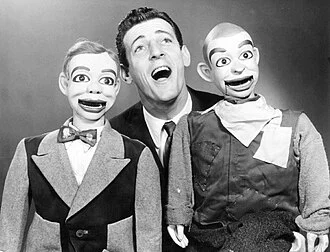
Television publicity
Separate NBC photograph from the 1950-1954 prime-time run; precise year is not recorded.
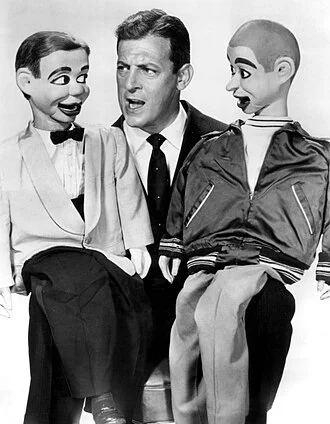
Television publicity
Archive publicity photograph with an October 1958 date stamp on the reverse.
Television Academy remembrance
https://www.televisionacademy.com/features/news/paul-winchell-1922-2005-ventriloquist-actor-inventor
Smithsonian Jerry Mahoney collection
https://americanhistory.si.edu/collections/object/nmah_214569
Lemelson-MIT inventor biography
https://lemelson.mit.edu/resources/paul-winchell
Winchell career biography
https://www.paulwinchell.com/bio.html
Hollywood Walk of Fame
https://walkoffame.com/paul-winchell/
Commons: portrait provenance and license
https://commons.wikimedia.org/wiki/File:Jerry%20Mahoney%20and%20Paul%20Winchell%20circa%201950.jpg
Corrections: hello@dailytimecapsule.com
Work: Jerry Mahoney and Paul Winchell circa 1950.jpg
Creator: NBC Television
Date: Earliest stamp is February 21, 1950
Original source: https://commons.wikimedia.org/wiki/File:Jerry%20Mahoney%20and%20Paul%20Winchell%20circa%201950.jpg
Primary archive: https://commons.wikimedia.org/wiki/File:Jerry%20Mahoney%20and%20Paul%20Winchell%20circa%201950.jpg
License: Public domain
License URI: https://commons.wikimedia.org/wiki/File:Jerry_Mahoney_and_Paul_Winchell_circa_1950.jpg
Changes: Resized and converted to WebP; portrait also placed in a titled share image. No endorsement implied.
Rights scope: No endorsement implied. See the stated license and modification notice.
Work: Jerry Mahoney Paul Winchell Knucklehead Smiff.JPG
Creator: NBC Television
Date: Release doesn't give a year. en:The Paul Winchell Show aired in prime-time from 1950 to 1954. The release indicates this was aired during what is considered prime-time. The NBC logo on the release is also in keeping with the time period.
Original source: https://commons.wikimedia.org/wiki/File:Jerry%20Mahoney%20Paul%20Winchell%20Knucklehead%20Smiff.JPG
Primary archive: https://commons.wikimedia.org/wiki/File:Jerry%20Mahoney%20Paul%20Winchell%20Knucklehead%20Smiff.JPG
License: Public domain
License URI: https://commons.wikimedia.org/wiki/File:Jerry_Mahoney_Paul_Winchell_Knucklehead_Smiff.JPG
Changes: Resized and converted to WebP; portrait also placed in a titled share image. No endorsement implied.
Rights scope: No endorsement implied. See the stated license and modification notice.
Work: Paul Winchell 1958.JPG
Creator: ABC Television-there is enough of the release left to be able to identify this as ABC by the portion of the logo remaining.
Date: There is an October 1958 date stamp in the news clipping on back.
Original source: https://commons.wikimedia.org/wiki/File:Paul%20Winchell%201958.JPG
Primary archive: https://commons.wikimedia.org/wiki/File:Paul%20Winchell%201958.JPG
License: Public domain
License URI: https://commons.wikimedia.org/wiki/File:Paul_Winchell_1958.JPG
Changes: Resized and converted to WebP; portrait also placed in a titled share image. No endorsement implied.
Rights scope: No endorsement implied. See the stated license and modification notice.