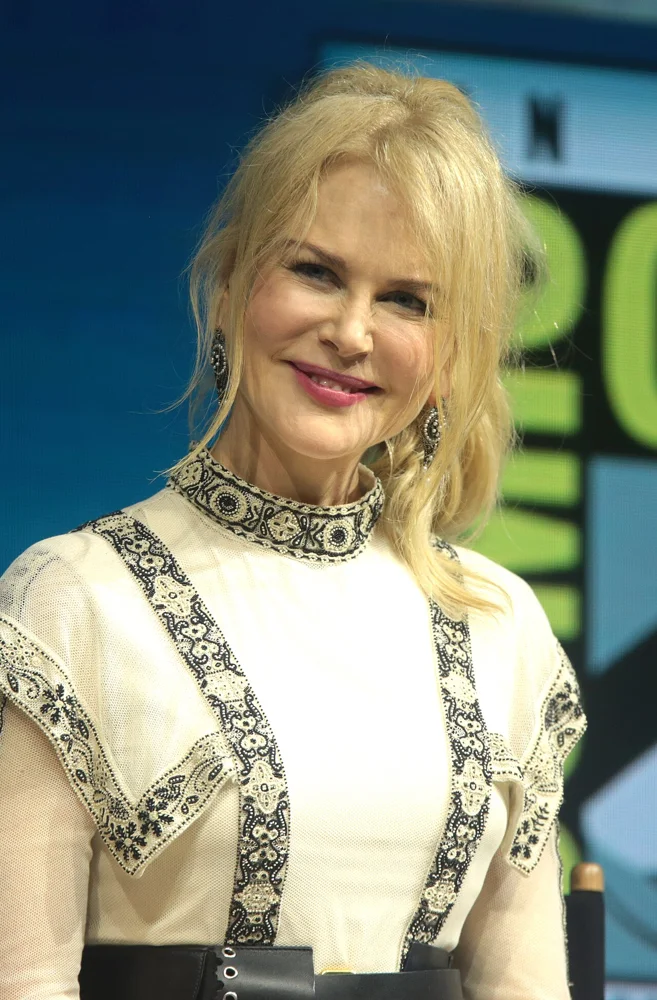
San Diego Comic-Con (2018)
Nicole Kidman
Kidman speaking at San Diego Comic-Con in 2018.
Entry point: Moulin Rouge! (2001).
Explore the career in pictures
Updated
Nicole Kidman is an Australian and American actress and producer whose career spans Australian film, Hollywood studio productions, independent cinema, television and theatre. The musical Moulin Rouge! offers one particularly vivid introduction, but it represents only one part of her work. Her screen characters range from the calculating television aspirant in To Die For to the writer Virginia Woolf in The Hours. Across these settings, her filmography rewards attention to the relationship between a character's public composure and the emotions that threaten to disturb it.
Kidman's early screen work included the Australian films Bush Christmas and BMX Bandits in 1983. The National Portrait Gallery's biography places the television miniseries Vietnam and the thriller Dead Calm among the important steps before Days of Thunder introduced her to Hollywood filmmaking in 1990. That sequence matters: the international career grew from an existing body of Australian work. Her later movement between industries and genres continued a pattern of changing scale and setting, rather than a straightforward progression away from her first screen environment.
In Baz Luhrmann's Moulin Rouge!, Kidman plays Satine opposite Ewan McGregor. The 2001 film combines romantic melodrama with a deliberately heightened musical style, making movement, singing and visual presentation part of its storytelling. AFI records the performance as the source of her first Academy Award nomination for leading actress. For a viewer, its value as an entry point lies in that combination of emotional directness and theatrical artifice. Kidman's character must carry a romantic narrative within an unusually elaborate world, where a small shift in feeling can be framed by a large musical number.
The contrast with The Hours is striking. Playing Virginia Woolf in Stephen Daldry's 2002 film, Kidman works within a quieter dramatic register, and the performance won the Academy Award for leading actress. The National Portrait Gallery also records the BAFTA recognition. Placing the two films together is more revealing than treating either as a complete definition of her style. One asks the performer to inhabit spectacle; the other places emphasis on inward attention and the pressure of an interior life. Both depend on making a character's emotional circumstances legible.
Kidman's collaborations have repeatedly placed her within distinctive directors' worlds. The Golden Globes career record includes Gus Van Sant's To Die For, Jane Campion's The Portrait of a Lady, Stanley Kubrick's Eyes Wide Shut and Alejandro Amenabar's The Others. These films differ sharply in tone and form. The useful connection is not that their characters are alike, but that each gives the actor a specific dramatic framework. Viewers can compare the unsettling ambition of To Die For with the uncertainty of The Others without reducing either performance to a general image of glamour.
Stage and television work broaden the picture. AFI's retrospective records the London production of The Blue Room and her later work with Campion on Top of the Lake: China Girl. Producing became another strand through Blossom Films, established with Per Saari. Big Little Lies brought prominent television recognition, while the screen credits continued to range across intimate drama and large productions. These changes in format make the career useful for following how an established film performer adapts to serial storytelling and develops work from behind the camera as well.
A rewarding route through Kidman's work begins with an early Australian film, then moves between To Die For, Moulin Rouge!, The Hours and television. Such a sequence shows differences in pace, performance scale and collaboration that a list of awards cannot capture on its own. Her career remains active, so the earlier milestones are viewing guides rather than a final verdict. The gallery documents separate public appearances at San Diego Comic-Con in 2018 and Cannes in 2014, with distinct photographers and licenses. These are event photographs, not images of the fictional roles discussed above.
Distinct photographs from 2018 and 2014 document different moments in the career, with individual credits below.
Nicole Kidman
Kidman speaking at San Diego Comic-Con in 2018.
Nicole Kidman
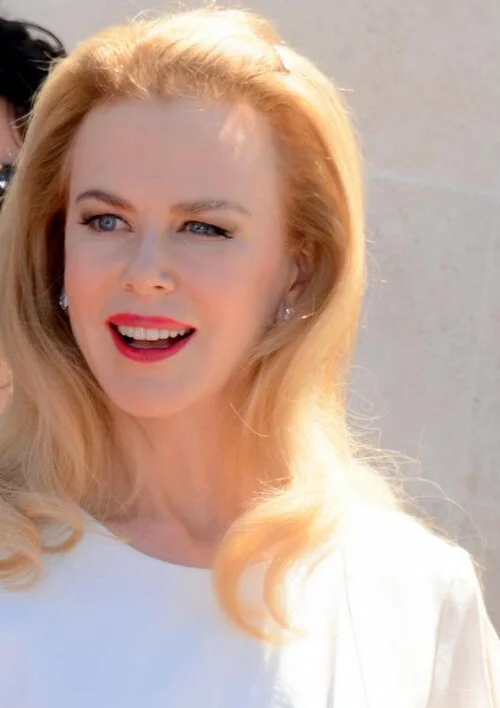
Kidman photographed at Cannes in May 2014.
AFI career retrospective
https://www.afi.com/laa/nicole-kidman/
National Portrait Gallery biography
https://www.portrait.gov.au/portraits/2005.106/nicole-kidman
Golden Globes career record
https://goldenglobes.com/person/nicole-kidman/
Commons: portrait provenance and license
https://commons.wikimedia.org/wiki/File:Nicole%20Kidman%20by%20Gage%20Skidmore.jpg
Corrections: hello@dailytimecapsule.com
Work: Nicole Kidman by Gage Skidmore.jpg
Creator: Gage Skidmore
Date: 2018-07-21
Original source: https://commons.wikimedia.org/wiki/File:Nicole%20Kidman%20by%20Gage%20Skidmore.jpg
Primary archive: https://commons.wikimedia.org/wiki/File:Nicole%20Kidman%20by%20Gage%20Skidmore.jpg
License: CC BY-SA 3.0
License URI: https://creativecommons.org/licenses/by-sa/3.0
Changes: Resized and converted; share image adds text; applicable share-alike terms retained.
Rights scope: No endorsement implied. See the stated license and modification notice.
Work: Nicole Kidman Cannes 2014.jpg
Creator: Georges Biard
Date: 2014-05
Original source: https://commons.wikimedia.org/wiki/File:Nicole%20Kidman%20Cannes%202014.jpg
Primary archive: https://commons.wikimedia.org/wiki/File:Nicole%20Kidman%20Cannes%202014.jpg
License: CC BY-SA 3.0
License URI: https://creativecommons.org/licenses/by-sa/3.0
Changes: Resized and converted; share image adds text; applicable share-alike terms retained.
Rights scope: No endorsement implied. See the stated license and modification notice.