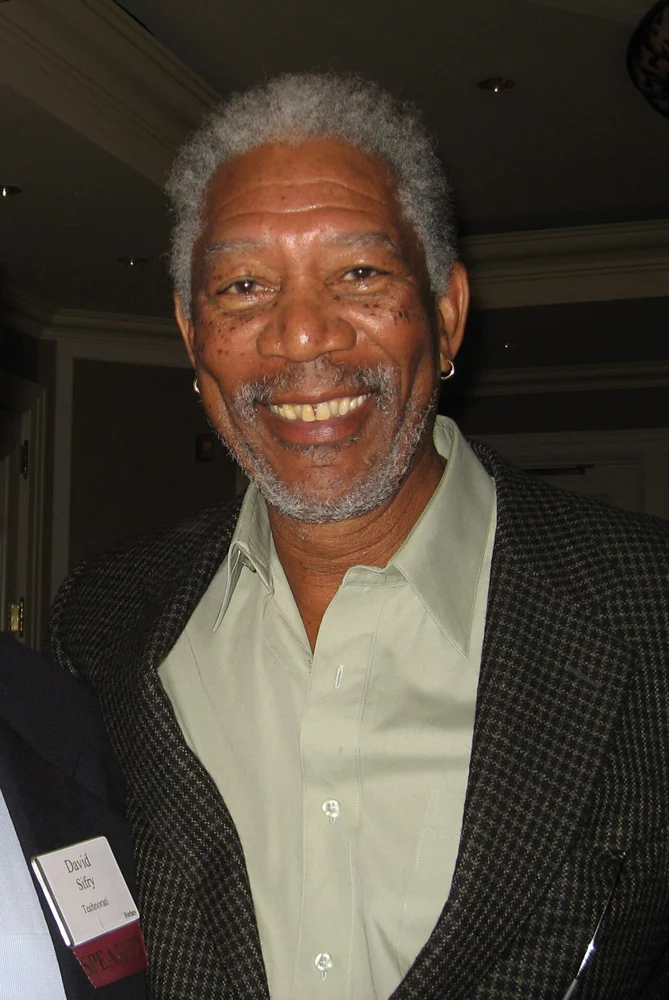
the Forbes MEET conference (2006)
Morgan Freeman
Morgan Freeman at the Forbes MEET conference in Los Angeles in 2006.
Entry point: The Shawshank Redemption (1994).
Explore the career in pictures
Updated
Morgan Freeman's screen career spans children's television, stage drama, crime films and major Hollywood productions. His role as Red in The Shawshank Redemption provides one entry point, but the earlier work changes the perspective: this was an experienced theatre and television performer before film stardom arrived. Freeman's performances invite attention to the relationship between speaking and listening. A familiar voice may draw a viewer into a scene, while a pause or a reaction establishes the character's position within it. The range of his credits is best explored across contrasting projects.
The Electric Company introduced Freeman to a national audience through Easy Reader. His stage career also brought substantial recognition: The Mighty Gents earned a Tony nomination, and his performances in Coriolanus, The Gospel at Colonus and Driving Miss Daisy won Obie Awards. Those productions involved very different theatrical traditions, from Shakespeare to contemporary American drama. The PBS biography records that breadth alongside the television credits. Looking back from the later films, the stage work supplies an important part of the career's foundation rather than a brief preface to celebrity.
In The Shawshank Redemption, Freeman plays Red alongside Tim Robbins. The film offers a particularly clear opportunity to consider narration and performance together: a character can guide the audience's understanding while also remaining part of the story unfolding on screen. For a rewatch, it is useful to notice how exchanges between the central performers carry the relationship, not only the passages that have become familiar in isolation. The role sits within a wider filmography that also includes the much harder-edged Fast Black in Street Smart and Ned Logan in Unforgiven.
The contrast between those roles is a useful corrective to a narrow idea of Freeman as a reassuring presence. Street Smart placed him in a threatening dramatic register, while other films used his composure in different ways. Comparing roles does not require treating an actor's public identity as the character's identity. Instead, watch how the surrounding scene changes the meaning of a quiet delivery, or how another performer's response alters the balance of power. Freeman's long experience across stage and screen gives viewers many opportunities to make that comparison.
Million Dollar Baby reunited Freeman with Clint Eastwood and paired them with Hilary Swank. Freeman's supporting performance earned the Academy Award presented in 2005; the film also won for picture, directing and Swank's leading performance. The awards record distinguishes the actor's individual recognition from the production's wider achievement. His work behind the camera supplies another part of the story: Bopha! marked his feature directing debut in 1993, with Danny Glover and Alfre Woodard in the cast. Acting, directing and narration therefore belong within the same career overview.
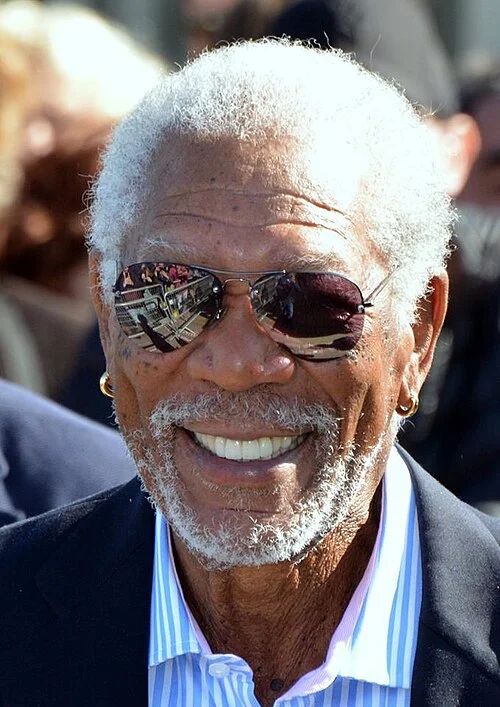
The two photographs show public appearances at different stages of that career. David Sifry photographed Freeman at the Forbes MEET conference in Los Angeles in 2006. Georges Biard's later image records him at the Deauville American Film Festival in 2018. These are separate event portraits, not images of Red or another screen character. Seeing them together offers a visual chronology while preserving their original context. Each photograph retains its own date, creator and Creative Commons license, with the source information presented alongside the gallery.
Freeman received the AFI Life Achievement Award in 2011 and was a 2015 National Medal of Arts recipient. The latter recognized his work across acting, directing and narration, an appropriately broad frame for revisiting the career. A viewing path can begin with The Electric Company's educational comedy, move through the stage-connected Driving Miss Daisy, and then compare the film work represented by The Shawshank Redemption and Million Dollar Baby. Such a path makes room for different collaborators and forms, instead of allowing any one celebrated role to stand for the whole.
Distinct photographs from 2006 and 2018 document different moments in the career, with individual credits below.
Morgan Freeman
Morgan Freeman at the Forbes MEET conference in Los Angeles in 2006.
Morgan Freeman
Morgan Freeman at Deauville in 2018; an event portrait, not a film still.
AFI career tribute
https://www.afi.com/laa/morgan-freeman/
PBS biography
https://www.pbs.org/weta/twoschools/documentary/thenarrator/
Academy Awards 2005
https://www.oscars.org/oscars/ceremonies/2005
National Medal of Arts
https://www.arts.gov/honors/medals/morgan-freeman
Commons: portrait provenance and license
https://commons.wikimedia.org/wiki/File:Morgan%20Freeman%2C%202006.jpg
Corrections: hello@dailytimecapsule.com
Work: Morgan Freeman, 2006.jpg
Creator: David Sifry
Date: 2006-10-24
Original source: https://commons.wikimedia.org/wiki/File:Morgan%20Freeman%2C%202006.jpg
Primary archive: https://commons.wikimedia.org/wiki/File:Morgan%20Freeman%2C%202006.jpg
License: CC BY 2.0
License URI: https://creativecommons.org/licenses/by/2.0
Changes: Resized and converted; share image adds text; applicable share-alike terms retained.
Rights scope: No endorsement implied. See the stated license and modification notice.
Work: Morgan Freeman Deauville 2018.jpg
Creator: Georges Biard
Date: 2018-09-02
Original source: https://commons.wikimedia.org/wiki/File:Morgan%20Freeman%20Deauville%202018.jpg
Primary archive: https://commons.wikimedia.org/wiki/File:Morgan%20Freeman%20Deauville%202018.jpg
License: CC BY-SA 4.0
License URI: https://creativecommons.org/licenses/by-sa/4.0
Changes: Resized and converted; share image adds text; applicable share-alike terms retained.
Rights scope: No endorsement implied. See the stated license and modification notice.