
Washington portrait, 1993 (1993)
Lynda Carter
Carter at Larry King’s birthday celebration in Washington, photographed by John Mathew Smith.
Entry point: Wonder Woman (1975).
Explore the career in pictures
Updated
Lynda Carter is an American actress and singer best known for playing Diana Prince and Wonder Woman on television. That role gave a widely recognized face to a comic-book heroine, but her professional life also includes concerts, recordings, television variety and voice work. Her official biography presents those musical and acting careers together. A retrospective is therefore most useful when it follows both: the physical performance and warmth of the superhero role, and the singer who continued to work in front of live audiences long after the original series ended.
Wonder Woman began in 1975 and remains the central screen reference in Carter’s career. She played both the heroine and her Diana Prince identity, working with Lyle Waggoner as Steve Trevor. In her Television Academy oral history, Carter discusses her approach to the character, the stunts she performed and her efforts to have a woman serve as her stunt double. Those recollections place the familiar costume and transformation within the practical work of making a weekly television adventure. The performance depended on acting, movement and a larger production team.
The series is an inviting entry point because Carter gives its larger-than-life premise a direct, approachable presence. A rewatch can focus on how she distinguishes Diana’s everyday interactions from the heroine’s physical confidence without treating them as unrelated people. The tone combines adventure with humor, and the relationship with Steve Trevor provides another part of that balance. Carter’s own retrospective account includes both her conception of Diana and the way the production developed. It is a reminder that an enduring screen image is built through many choices across successive episodes.
After Wonder Woman, Carter continued in entertainment rather than leaving performance behind with one character. Her Television Academy interview covers her television variety specials, The Muppet Show and later voice work for games. Her official site also documents her continuing career as a singer-songwriter. These forms ask for different relationships with an audience: a recurring fictional role, a musical appearance and a voice performance do not make the same demands. Listening as well as watching gives a fuller sense of the performer than a collection of superhero images alone.
The public conversation around Carter’s work has also extended into cultural institutions. In June 2017, Librarian of Congress Carla Hayden interviewed her during the Library of Awesome celebrations. The Library’s account places the appearance alongside exhibits and programs about comics. Its later Wonder Woman display included an illustration by Cat Staggs and a script from Patty Jenkins’s 2017 film. These were separate objects and contributions, not work authored by Carter; together, the programs show how her television portrayal became part of a wider history of the character.
The two photographs in this gallery come from different decades and occasions. John Mathew Smith photographed Carter at Larry King’s birthday celebration in Washington in 1993. Tim Evanson photographed her as grand marshal at Washington’s Capital Pride parade in 2013. Neither image is a Wonder Woman production still. Their value here is biographical: they show the performer’s public presence well beyond the original television run. The dates identify the photographed occasions, while the credits identify the individual photographers and the terms under which the images are reproduced.
Carter’s lasting association with Wonder Woman is both a starting point and an invitation to look further. The original series preserves the role that made her internationally familiar; her musical work and later appearances show other parts of a sustained performing career. For viewers returning to the series, the oral-history interview offers context for the craft behind its recognizable moments. For those who know only the costume, a concert performance or variety appearance provides a different introduction to the same artist.
Distinct photographs from 1993 and 2013 document Carter’s public appearances beyond her original Wonder Woman television run.
Lynda Carter
Carter at Larry King’s birthday celebration in Washington, photographed by John Mathew Smith.
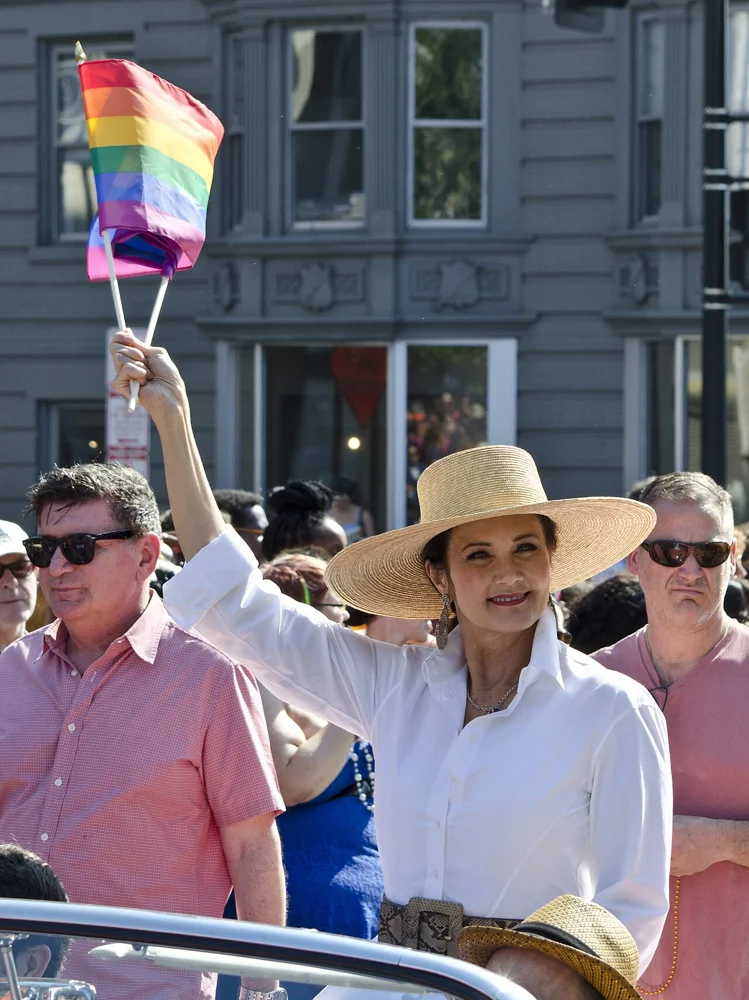
Lynda Carter
Carter as grand marshal of Washington’s Capital Pride parade, photographed by Tim Evanson.
Lynda Carter: official biography
https://www.lyndacarter.com/about/
Television Academy: Lynda Carter oral history
https://interviews.televisionacademy.com/interviews/lynda-carter
Library of Congress: Library of Awesome
https://www.loc.gov/item/2021690557/
Library of Congress: Wonder Woman treasures
https://blogs.loc.gov/music/2017/07/new-wonder-woman-treasures-on-display/
Commons: portrait provenance and license
https://commons.wikimedia.org/wiki/File:Lynda%20Carter%201993.jpg
Corrections: hello@dailytimecapsule.com
Work: Lynda Carter 1993.jpg
Creator: John Mathew Smith / Kingkongphoto
Date: 1993-11-19
Original source: https://commons.wikimedia.org/wiki/File:Lynda%20Carter%201993.jpg
Primary archive: https://commons.wikimedia.org/wiki/File:Lynda%20Carter%201993.jpg
License: CC BY-SA 2.0
License URI: https://creativecommons.org/licenses/by-sa/2.0
Changes: Resized and converted; share image adds text; applicable share-alike terms retained.
Rights scope: No endorsement implied. See the stated license and modification notice.
Work: Lynda Carter 2013.jpg
Creator: Tim Evanson
Date: 2013-06-08
Original source: https://commons.wikimedia.org/wiki/File:Lynda%20Carter%202013.jpg
Primary archive: https://commons.wikimedia.org/wiki/File:Lynda%20Carter%202013.jpg
License: CC BY-SA 2.0
License URI: https://creativecommons.org/licenses/by-sa/2.0
Changes: Resized and converted; share image adds text; applicable share-alike terms retained.
Rights scope: No endorsement implied. See the stated license and modification notice.