
Studio publicity portrait (Date not established)
Lee Patrick
Studio publicity photograph; no specific production is assigned.
Entry point: The Maltese Falcon (1941).
Explore the career in pictures
Updated
Lee Patrick was an American character actress whose screen work could move from the practical efficiency of a detective's secretary to the fluttering concerns of a society wife. Effie Perine in the 1941 The Maltese Falcon remains her best-known film role, while Henrietta Topper gave television audiences a recurring acquaintance with her comedy. The two characters offer a useful starting point for a career built on supporting performances that make the worlds around leading characters more complete and more distinctive.
Patrick began on the New York stage during the 1920s, appearing in musicals, comedies and dramatic work before building a sustained Hollywood career. Her early credits included The Bunch and Judy and a stage production of Little Women. That theatrical background preceded a long succession of film appearances. A studio publicity portrait introduces the actress in the gallery, while a later Topper cast photograph records the television ensemble. The photographs serve different purposes: one presents the performer alone, and the other places her within a familiar group.
In John Huston's The Maltese Falcon, Patrick's Effie works for Humphrey Bogart's Sam Spade. AFI identifies her in that role in the 1941 adaptation, which also stars Mary Astor, Peter Lorre and Sydney Greenstreet. Effie belongs to Spade's everyday professional world, in contrast with the suspicious visitors and competing stories that enter his office. Her presence helps establish that world quickly. This is Patrick's role in the Bogart film, not the same character's portrayal in the earlier 1931 adaptation of Dashiell Hammett's novel.
Patrick returned to Effie in The Black Bird in 1975, a comic continuation built around George Segal as Sam Spade Jr. The return gives viewers an unusual opportunity to compare the same actress and character across very different treatments of familiar material. The later film does not simply repeat Huston's detective story; it changes the comic framework and the central Spade. Keeping the two productions separate makes Patrick's participation clearer and preserves the distinction between the original supporting performance and its much later reprise.
On television, Topper paired Patrick as Henrietta with Leo G. Carroll as Cosmo Topper. Anne Jeffreys and Robert Sterling played the ghostly Marion and George Kerby. The series' central joke depends on Cosmo's encounters with people others cannot see, while Henrietta inhabits the apparently ordinary household around him. Patrick's performance therefore helps sustain the domestic side of a supernatural comedy. The programme also makes a useful contrast with Effie: the actress's manner and reactions serve a different relationship and a different kind of confusion.
Her other films included Caged, Mildred Pierce, Auntie Mame and Pillow Talk, demonstrating the breadth of a supporting career across drama and comedy. In Auntie Mame she played Doris Upson, a society figure within Rosalind Russell's much larger comic world. Those appearances show why a retrospective should look beyond the single role most often attached to her name. A familiar actor can alter a scene's social atmosphere without being its main focus, and Patrick's credits provide several settings in which to observe that contribution.
Patrick died in 1982 after withdrawing from regular screen work. For a compact introduction, watch The Maltese Falcon, sample the television Topper and then compare the later Effie in The Black Bird. The gallery's ensemble photograph identifies the television cast rather than illustrating the earlier Topper films, which used different performers. That pairing of solo portrait and cast image keeps the actress visible both as an individual and as part of the collaborative screen work through which audiences came to know her.
A solo publicity portrait and a distinct television cast photograph introduce Patrick and her work as Henrietta Topper.
Lee Patrick
Studio publicity photograph; no specific production is assigned.
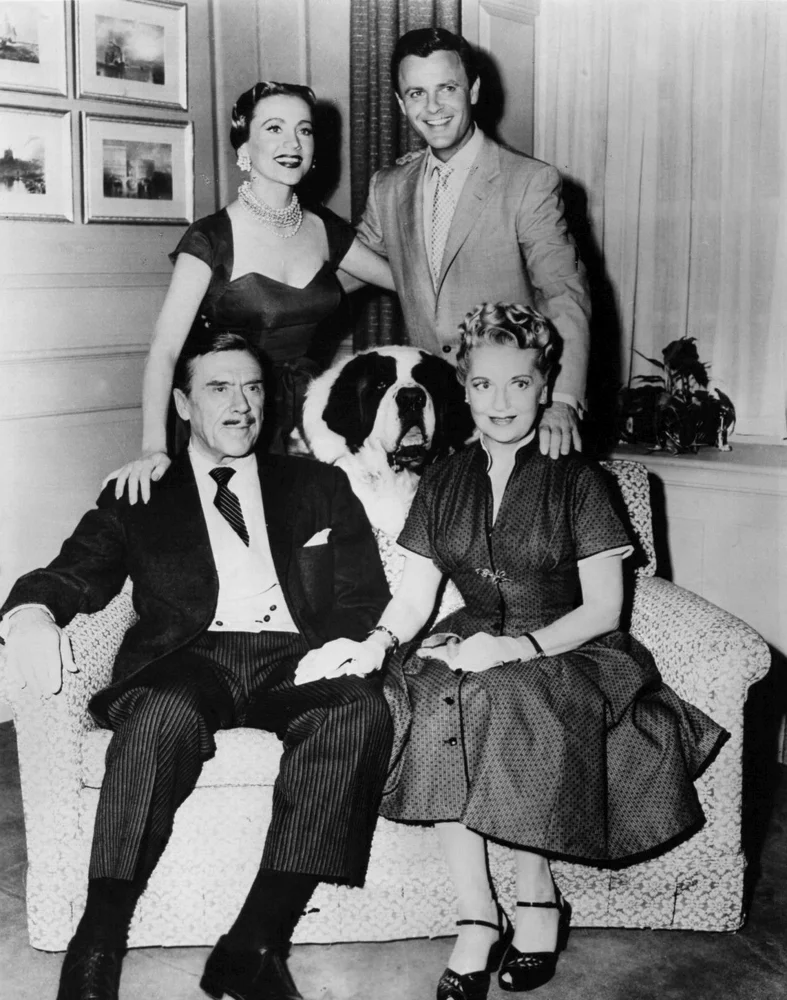
Henrietta Topper
Seated: Leo G. Carroll and Lee Patrick. Standing: Anne Jeffreys and Robert Sterling; Neil the dog is between them.
Career biography
https://en.wikipedia.org/wiki/Lee_Patrick_(actress)
AFI: The Maltese Falcon (1941)
https://catalog.afi.com/Film/27025-THE-MALTESEFALCON
AFI: The Black Bird
https://catalog.afi.com/Film/55513-THE-BLACK-BIRD
IMDb: Lee Patrick biography and credits
https://www.imdb.com/name/nm0665886/
Commons: portrait provenance and license
https://commons.wikimedia.org/wiki/File:LEEPatrick.jpg
Corrections: hello@dailytimecapsule.com
Work: LEEPatrick.jpg
Creator: Studio Publicity
Date: Circa 1940s
Original source: https://commons.wikimedia.org/wiki/File:LEEPatrick.jpg
Primary archive: https://commons.wikimedia.org/wiki/File:LEEPatrick.jpg
License: Public domain
License URI: https://commons.wikimedia.org/wiki/File:LEEPatrick.jpg
Changes: Resized and converted to WebP; portrait also placed in a titled share image. No endorsement implied.
Rights scope: No endorsement implied. See the stated license and modification notice.
Work: Topper cast 1953.JPG
Creator: Saul Krieg Associates, New York. This looks to be a public relations agency who distributed the material on behalf of either CBS or the show sponsor, R.J. Reynolds Camel cigarettes. It was common for a sponsor, network or studio to use either an ad or publicity agency to distribute publicity information and material. There's also an ABC release from 1955, when the series began airing there.
Date: No date shown but release says the show premiered 9 October--it did so in 1953 When it finished its run on CBS, the reruns were broadcast by both NBC and ABC Television. ABC began airing the series on October 3, 1955 .
Original source: https://commons.wikimedia.org/wiki/File:Topper%20cast%201953.JPG
Primary archive: https://commons.wikimedia.org/wiki/File:Topper%20cast%201953.JPG
License: Public domain
License URI: https://commons.wikimedia.org/wiki/File:Topper_cast_1953.JPG
Changes: Resized and converted to WebP; portrait also placed in a titled share image. No endorsement implied.
Rights scope: No endorsement implied. See the stated license and modification notice.