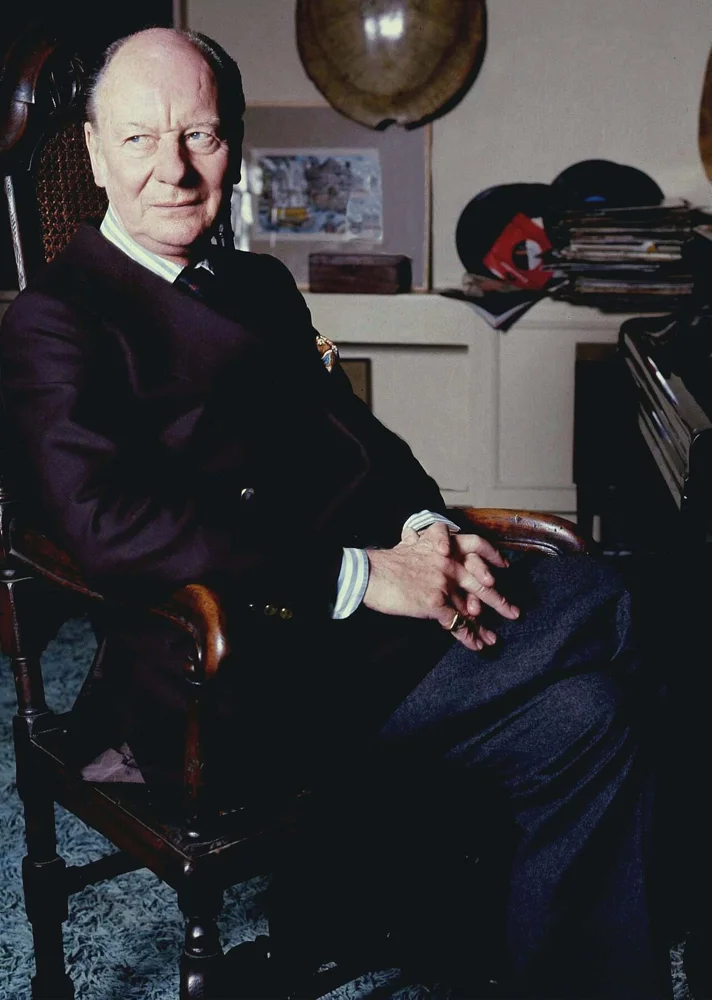
Portrait by Allan Warren (1973)
John Gielgud
Allan Warren portrait photograph.
Entry point: Julius Caesar (1953).
Explore the career in pictures
Updated
John Gielgud was an English actor and theatre director whose long career helped connect twentieth-century Shakespearean performance with a remarkably varied screen repertoire. His stage reputation rested in part on his command of language, but his films also reveal a sharp comic intelligence. Cassius in Julius Caesar, Hobson in Arthur and Prospero in Prospero's Books offer three very different introductions. Together they show how a performer associated with classical theatre could become equally memorable within a Hollywood comedy and an experimental literary film.
Hamlet was central to his theatrical life. The Royal Shakespeare Company's history records five productions in which he played the role between 1930 and 1944, followed by his direction of Richard Burton's New York Hamlet in 1964. That history includes interpretation from both sides of the stage: performing the prince and later guiding another actor through the part. It also places the familiar screen personality within decades of theatrical work, where returning to a role could become a continuing process rather than a single defining appearance.
The 1953 film Julius Caesar provides a direct bridge from Shakespeare to cinema. Gielgud plays Cassius, alongside James Mason as Brutus and Marlon Brando as Mark Antony, under Joseph L. Mankiewicz's direction. His role is not Caesar himself. Cassius's persuasion and calculation make the exchanges with Brutus especially useful to revisit, attending to how an argument changes as it meets resistance. The trailer frame in this gallery identifies him by name and character, preserving a contemporary piece of the film's promotional presentation.
Arthur, released in 1981, brought his precise delivery into a contemporary comic setting. As Hobson, the butler to Dudley Moore's wealthy, irresponsible Arthur, Gielgud turns formal service into a relationship full of cutting responses and underlying affection. The Academy awarded him the supporting-actor Oscar at its 1982 ceremony for this performance. The film year and ceremony year are different. A comparison with Cassius reveals how clarity of speech can serve radically different ends, from political persuasion to a comic exchange whose effect depends on timing.
His later screen career included work with directors as different as David Lynch, Richard Attenborough and Peter Greenaway. The Elephant Man, Gandhi and Prospero's Books occupy distinct cinematic worlds, and Gielgud's presence did not make them variations on a single theatrical style. The range is worth retaining when introducing an actor so strongly associated with Shakespeare. Even a comparatively brief appearance can alter a film's sense of authority or social position, while a central performance allows that authority to become more complicated through the story.
Greenaway's Prospero's Books, released in 1991, returns to Shakespeare through The Tempest. Gielgud plays Prospero within a film that combines performance with layered imagery, movement and digital experimentation. The BFI describes it as an unconventional adaptation rather than a straightforward recording of the play. Watching it after Julius Caesar makes the difference in cinematic approach clear: the earlier film organizes a political drama around scenes and confrontations, while Greenaway builds an elaborate visual environment around the act of imagining and speaking the text.
A useful introduction therefore moves between Julius Caesar, Arthur and Prospero's Books rather than treating one celebrated role as a complete account. Gielgud's career also belongs to theatre history, where his acting and directing extended beyond what a film list can preserve. Allan Warren's 1973 portrait and the earlier trailer image give the gallery two different kinds of evidence: a photographic sitting and a named screen character. Together with the selected credits, they invite viewers to explore the relationship between his vocal precision, comic judgment and changing performance contexts.
A 1973 portrait and a 1953 trailer frame distinguish the performer from his screen role as Cassius. The trailer image retains its original identifying title.
John Gielgud
Allan Warren portrait photograph.
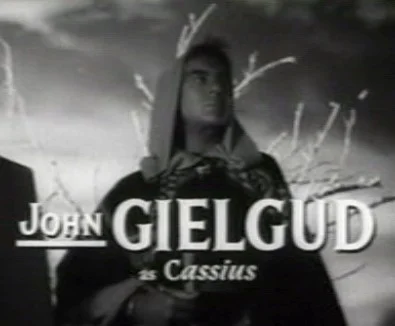
John Gielgud as Cassius
Cropped trailer frame; the archive records US public-domain status for the trailer image.
Stage history of Hamlet
https://www.rsc.org.uk/hamlet/about-the-play/stage-history
Career biography
https://goldenglobes.com/person/john-gielgud/
Academy Awards record
https://www.oscars.org/oscars/ceremonies/1982/O
Prosperos Books
https://player.bfi.org.uk/subscription/film/watch-prosperos-books-1991-online
Stage and screen credits
https://en.wikipedia.org/wiki/John_Gielgud_on_stage_and_screen
Commons: portrait provenance and license
https://commons.wikimedia.org/wiki/File:John%20Gielgud%20Allan%20Warren.jpg
Corrections: hello@dailytimecapsule.com
Work: John Gielgud Allan Warren.jpg
Creator: Allan warren
Date: 1973
Original source: https://commons.wikimedia.org/wiki/File:John%20Gielgud%20Allan%20Warren.jpg
Primary archive: https://commons.wikimedia.org/wiki/File:John%20Gielgud%20Allan%20Warren.jpg
License: CC BY-SA 3.0
License URI: https://creativecommons.org/licenses/by-sa/3.0
Changes: Resized and converted to WebP; portrait also placed in a titled share image. No endorsement implied. These image derivatives remain available under CC BY-SA 3.0.
Rights scope: No endorsement implied. See the stated license and modification notice.
Work: John Gielgud in Julius Caesar trailer.jpg
Creator: Trailer screenshot
Date: 1953
Original source: https://commons.wikimedia.org/wiki/File:John%20Gielgud%20in%20Julius%20Caesar%20trailer.jpg
Primary archive: https://commons.wikimedia.org/wiki/File:John%20Gielgud%20in%20Julius%20Caesar%20trailer.jpg
License: Public domain
License URI: https://commons.wikimedia.org/wiki/File:John_Gielgud_in_Julius_Caesar_trailer.jpg
Changes: Resized and converted to WebP; portrait also placed in a titled share image. No endorsement implied.
Rights scope: No endorsement implied. See the stated license and modification notice.