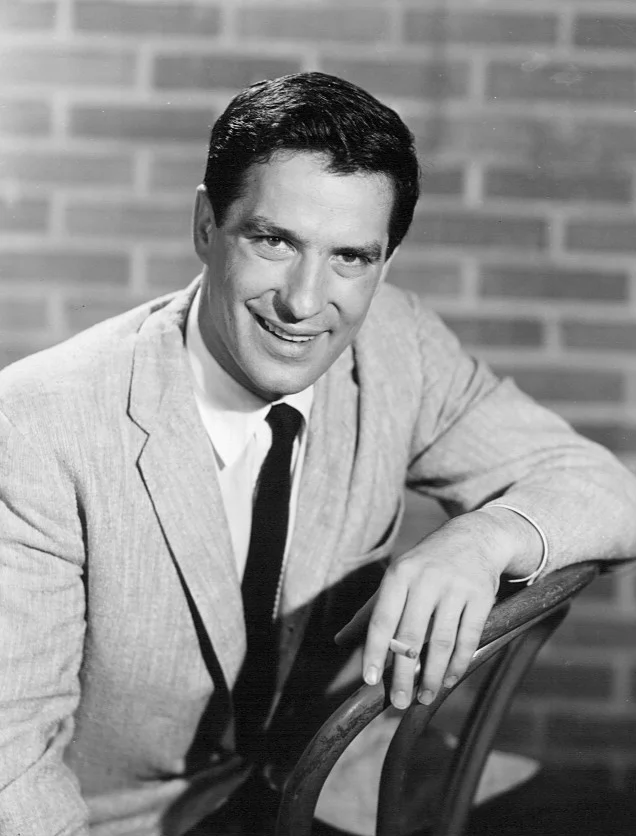
Cassavetes as Johnny Staccato (1959)
Television publicity portrait
A portrait from the series’ publicity record, with its source context retained.
Entry point: Johnny Staccato (1959–1960).
Explore the career in pictures
Updated
John Cassavetes worked as both an actor and filmmaker, and those two careers are best understood together. Viewers may encounter him in Edge of the City, the jazz-detective series Johnny Staccato or Rosemary's Baby before exploring the independent films he directed. Shadows, Faces and A Woman Under the Influence offer another route into the work. The gallery begins with a television publicity portrait and then turns to a film image and an appearance with Gena Rowlands. These records document actual productions and performers rather than supplying unrelated film artwork as a substitute for career photographs.
Cassavetes's directing developed from an actor's interest in performance. Criterion identifies Shadows as his 1959 directorial debut and describes its New York setting and central relationships. The film is a useful place to examine how a scene can move through embarrassment, attraction or misunderstanding without presenting a character as a fixed type. Its production history should not be simplified into the claim that everything was improvised. The BFI's introduction to his work distinguishes the films and the working methods behind them. A selected viewing path can begin there without pretending to account for every version of a production.
Johnny Staccato is the television entry point for this page. Cassavetes played a pianist and detective, a role that connected a musical milieu with the familiar structure of crime television. The individual publicity portrait and photograph with Rowlands belong to that television context. A publicity image is designed to introduce a performer or program, and does not necessarily document an unrehearsed moment between the people pictured. Compare an episode's controlled narrative movement with one of his independently directed films, paying attention to how a conversation changes when the camera allows it more room.
Edge of the City placed Cassavetes beside Sidney Poitier in a 1957 drama. The gallery's image derives from the film's trailer, with its own archival provenance. It is not a newly licensed studio portrait or a still attributed to an unidentified photographer. The film provides an acting comparison with Johnny Staccato: one character develops inside a feature-length relationship while the series role must carry an episode's investigation. The distinction helps keep the actor's presence from being treated simply as an illustration of the films he would later direct.
Faces, released in 1968, examines relationships through a concentrated ensemble. The BFI's account places it within Cassavetes's independent production history and notes the screenplay's Academy Award nomination. A viewer can watch for shifts in attention rather than asking only which character explains the plot. The screenplay recognition also matters when discussing spontaneity: an intense or unsettled performance is not evidence that no writing was involved. The film's form and production choices can be explored alongside, rather than erased by, a general legend about an improvising director.
Gena Rowlands became a central collaborator in films including A Woman Under the Influence and Opening Night. The BFI's study of the partnership connects performance, writing and the practical work of making the films. Other recurrent collaborators included Peter Falk and Ben Gazzara. Their repeated presence gives viewers a way to compare different roles without assuming that a familiar ensemble always produces the same result. The Rowlands photograph in this gallery is labeled for its 1959 television-publicity source; it is not reassigned to a later film simply because the same two people made that film together.
Cassavetes's legacy includes independent filmmaking as well as performances for other directors. Revisit an acting role, then move to Shadows, Faces or a Rowlands collaboration to see the different positions he occupied in relation to the camera. The selected credits distinguish acting from directing, and the pictures preserve their original program and production labels. That distinction makes rediscovery more useful than a single list of titles. This page introduces major work and documented collaborations without treating a trailer frame, publicity portrait or critical retrospective as an exhaustive account of the artist's life.
A television portrait, feature-film trailer frame and television publicity with Gena Rowlands document specific work. The images are not assigned to later productions merely because the performers reappear together.
Television publicity portrait
A portrait from the series’ publicity record, with its source context retained.

Trailer frame
An archival trailer frame from the 1957 film, identified as such rather than a studio portrait.
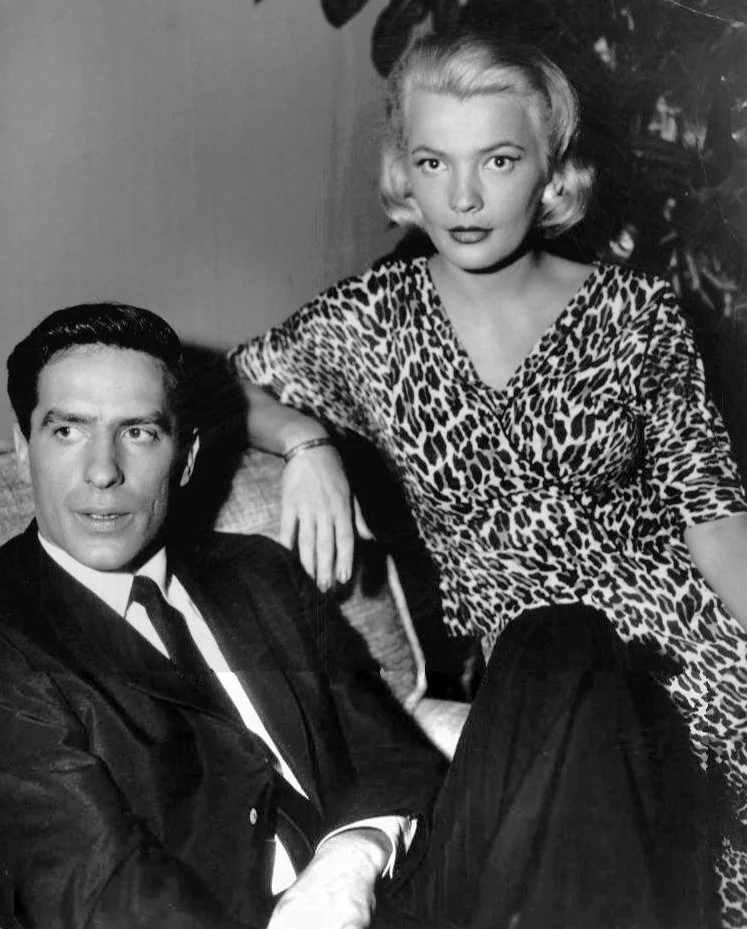
Johnny Staccato publicity
Television publicity featuring both performers; not relabeled as a later independent-film still.
BFI: where to begin with John Cassavetes
https://www.bfi.org.uk/features/where-begin-john-cassavetes
Criterion Collection: Shadows
https://www.criterion.com/films/500-shadows
BFI: Faces and independent filmmaking
https://www.bfi.org.uk/features/john-cassavetes-faces-indie-filmmaking
BFI: John Cassavetes and Gena Rowlands
https://www.bfi.org.uk/features/john-gena-dynamite-screen
Commons: portrait provenance and license
https://commons.wikimedia.org/wiki/File:John%20Cassavetes%20as%20Johnny%20Staccato%201959.jpg
Corrections: hello@dailytimecapsule.com
Work: John Cassavetes as Johnny Staccato 1959.jpg
Creator: NBC Television
Date: 1959
Original source: https://commons.wikimedia.org/wiki/File:John%20Cassavetes%20as%20Johnny%20Staccato%201959.jpg
Primary archive: https://commons.wikimedia.org/wiki/File:John%20Cassavetes%20as%20Johnny%20Staccato%201959.jpg
License: Public domain
License URI: https://commons.wikimedia.org/wiki/File:John_Cassavetes_as_Johnny_Staccato_1959.jpg
Changes: Resized and converted to WebP; portrait also placed in a titled share image. No endorsement implied.
Rights scope: No endorsement implied. See the stated license and modification notice.
Work: John Cassavetes Edge of the City trailer 1957.jpg
Creator: Metro-Goldwyn-Mayer
Date: 1957
Original source: https://commons.wikimedia.org/wiki/File:John%20Cassavetes%20Edge%20of%20the%20City%20trailer%201957.jpg
Primary archive: https://commons.wikimedia.org/wiki/File:John%20Cassavetes%20Edge%20of%20the%20City%20trailer%201957.jpg
License: Public domain
License URI: https://commons.wikimedia.org/wiki/File:John_Cassavetes_Edge_of_the_City_trailer_1957.jpg
Changes: Resized and converted to WebP; portrait also placed in a titled share image. No endorsement implied.
Rights scope: No endorsement implied. See the stated license and modification notice.
Work: John Cassavetes Gena Rowlands Johnny Staccato 1959.JPG
Creator: The Bureau of Industrial Service for NBC-TV. In the 1950s and 1960s, ad and public relations agencies often distributed publicity materials for networks, program sponsors and studios. The Bureau was a division of ad agency Young & Rubicam, and was widely used by the industry for this purpose.
Date: 1959-10-21
Original source: https://commons.wikimedia.org/wiki/File:John%20Cassavetes%20Gena%20Rowlands%20Johnny%20Staccato%201959.JPG
Primary archive: https://commons.wikimedia.org/wiki/File:John%20Cassavetes%20Gena%20Rowlands%20Johnny%20Staccato%201959.JPG
License: Public domain
License URI: https://commons.wikimedia.org/wiki/File:John_Cassavetes_Gena_Rowlands_Johnny_Staccato_1959.JPG
Changes: Resized and converted to WebP; portrait also placed in a titled share image. No endorsement implied.
Rights scope: No endorsement implied. See the stated license and modification notice.