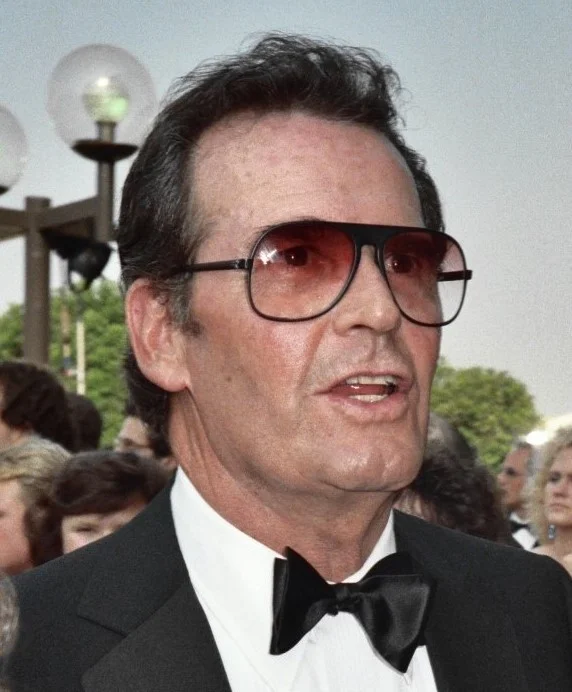
Emmy Awards appearance (1987)
James Garner
Alan Light photograph from September 1987.
Entry point: Maverick (1957).
Explore the career in pictures
Updated
James Garner was an American film and television actor whose best-known characters include Bret Maverick and Jim Rockford. Born in Norman, Oklahoma, in 1928, he worked across more than five decades before his death in 2014. His career joined a relaxed screen manner with roles that often complicated conventional ideas of a hero. A gambler who preferred avoiding trouble and a private investigator with practical worries gave audiences distinctive alternatives to the invulnerable leading man, while his films offered romance, comedy and dramatic contrasts.
Garner's early stage work included a nonspeaking part in The Caine Mutiny Court-Martial, arranged through agent and producer Paul Gregory. The production brought him into contact with Henry Fonda, whose naturalistic acting made a lasting impression. Warner Bros. film and television work followed. His 1999 oral history preserves his own account of the transition, including the possibility of an earlier role in Cheyenne. These beginnings are useful context for the apparent ease of his later performances: screen confidence emerged from working around experienced performers and learning within practical production settings.
Maverick began in 1957 with Garner as Bret, a frontier gambler whose adventures developed a strong comic streak. Roy Huggins created the series, and Jack Kelly joined as Bret's brother Bart. Alternating the brothers' stories helped the production meet its weekly schedule; some episodes brought them together. The program's willingness to parody familiar Western conventions made Garner's timing especially important. A reaction, a hesitation or a strategically pleasant manner could carry a joke without requiring the character to announce that he was part of a comic Western.
In his oral history, Garner described Maverick as a reluctant hero who preferred smiling to fighting. The distinction remains a useful way to approach his work, provided it does not become a claim that every role was identical. The same interview ranges through The Americanization of Emily, Grand Prix, Nichols and later television films. Each required a different fictional world. The continuity lies in the audience's familiarity with the performer, while the differences emerge from the circumstances, partners and choices of the particular character.
The Rockford Files placed Garner in contemporary Los Angeles as private investigator Jim Rockford. Its supporting relationships gave the detective a life beyond the case of the week: Joe Santos played police friend Dennis Becker, Gretchen Corbett played attorney Beth Davenport, and Stuart Margolin played Angel Martin. These recurring figures provided contrasting pressures and loyalties around Rockford. For viewers, those relationships are an especially rewarding route into the series because the detective's character is revealed through exchanges with people who know him, not only through encounters with a new client or suspect.
Garner won the lead-actor drama Emmy for The Rockford Files in 1977 and later shared an executive-producer Emmy for Promise in 1987. His film work included The Great Escape, The Children's Hour, Support Your Local Sheriff!, Victor/Victoria and Murphy's Romance, the latter bringing an Oscar nomination. The Television Academy inducted him into its Hall of Fame in 1991. These dated distinctions span performance and production, and they place the two familiar television leads within a much broader record of screen work.
The gallery pairs a 1987 Emmy appearance with a separate Rockford Files publicity photograph associated with the 1974 episode Tall Woman in Red Wagon. One documents Garner at an industry event; the other shows him in a production context with fellow performers. Their separate credits and rights records are retained. A viewing path from Maverick to The Rockford Files, then into the films discussed in his oral history, makes it possible to compare the comedy of evasion, the demands of an ensemble mystery and the different rhythms of feature filmmaking.
An awards portrait and a separately sourced television publicity image show Garner in public and in character.
James Garner
Alan Light photograph from September 1987.
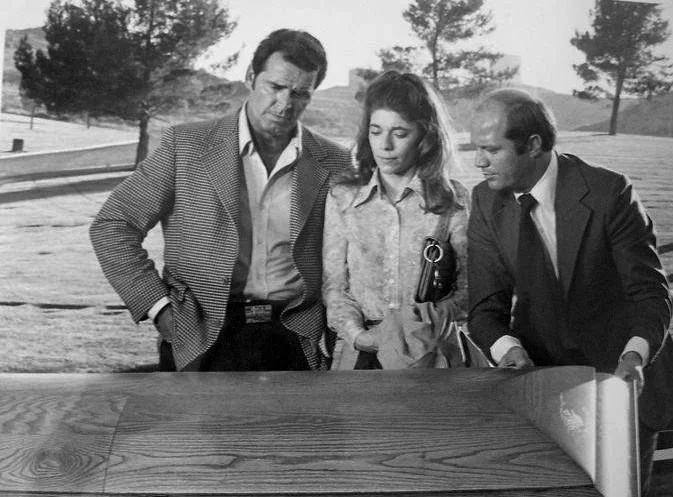
James Garner, Sian Barbara Allen and Dave Morick
NBC publicity image for Tall Woman in Red Wagon; episode aired in 1974.
Television Academy: James Garner
https://www.televisionacademy.com/bios/james-garner
Television Academy: Garner oral history
https://interviews.televisionacademy.com/interviews/james-garner
Museum of Broadcast Communications: Maverick
https://interviews.televisionacademy.com/shows/maverick
Museum of Broadcast Communications: The Rockford Files
https://interviews.televisionacademy.com/shows/rockford-files-the
Commons: portrait provenance and license
https://commons.wikimedia.org/wiki/File:James%20Garner%201987.jpg
Corrections: hello@dailytimecapsule.com
Work: James Garner 1987.jpg
Creator: Alan Light
Date: 1987-09
Original source: https://commons.wikimedia.org/wiki/File:James%20Garner%201987.jpg
Primary archive: https://commons.wikimedia.org/wiki/File:James%20Garner%201987.jpg
License: CC BY 2.0
License URI: https://creativecommons.org/licenses/by/2.0
Changes: Resized and converted to WebP; portrait also placed in a titled share image. No endorsement implied.
Rights scope: No endorsement implied. See the stated license and modification notice.
Work: James Garner Rockford Files 1974.JPG
Creator: NBC Television
Date: No year shown on release. The episode aired in 1974 .
Original source: https://commons.wikimedia.org/wiki/File:James%20Garner%20Rockford%20Files%201974.JPG
Primary archive: https://commons.wikimedia.org/wiki/File:James%20Garner%20Rockford%20Files%201974.JPG
License: Public domain
License URI: https://commons.wikimedia.org/wiki/File:James_Garner_Rockford_Files_1974.JPG
Changes: Resized and converted to WebP; portrait also placed in a titled share image. No endorsement implied.
Rights scope: No endorsement implied. See the stated license and modification notice.