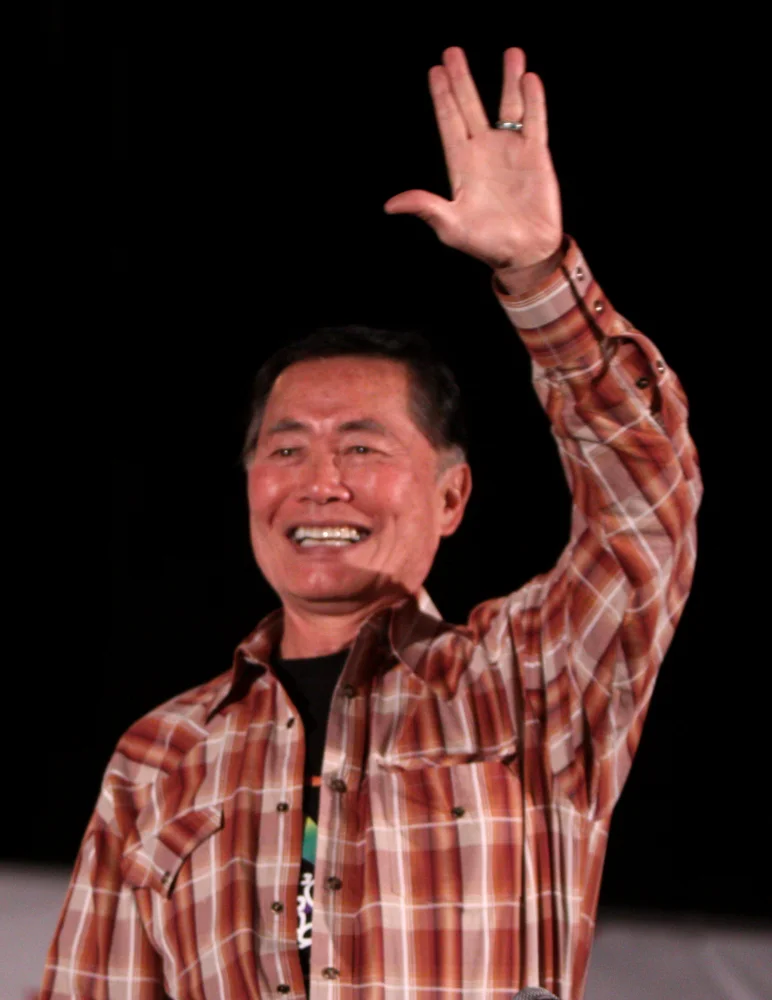
Photo: Gage Skidmore. George Takei at the 2011 Phoenix Comicon. CC BY-SA 3.0. Portrait resized and converted; share image cropped with text added. See the source and license details below. Image credits
Intro
George Takei is an American actor, author and public advocate whose screen career is closely associated with Hikaru Sulu in Star Trek. The role grew from a place on the Enterprise bridge into a continuing character across feature films and later television. His work also reaches into theater, animation and memoir. This guide starts with Sulu while making room for those other forms, using a credited portrait and production artwork to distinguish the actor's career from the fictional officer's changing rank.
Career snapshot
Takei studied theater at UCLA, earning undergraduate and graduate degrees in 1960 and 1964. The university describes a student who combined campus productions with professional film and television work. His official biography traces early voice work to the English-language version of Rodan and an on-camera television appearance to Playhouse 90. These beginnings offer a useful perspective on the later science-fiction identity: he had experience working with both a visible performance and a voice separated from the original image before audiences encountered Sulu.
The entry point
Star Trek reached television audiences in 1966 with a bridge crew drawn from different backgrounds. In an interview for the franchise's official site, Takei discussed the importance he placed on Sulu as a capable officer rather than a demeaning stereotype. That is the actor's account of what the opportunity meant to him. For a viewer, it provides a concrete point of attention: notice how the character belongs to the professional life of the ship even in scenes where another member of the ensemble carries the central story.
Screen identity and style
Sulu's move to command of the Excelsior in Star Trek VI: The Undiscovered Country gives a later performance a different position within the same fictional world. Takei returned as Captain Sulu in the Voyager episode Flashback. Comparing the bridge scenes makes the change especially clear: a familiar character can retain his recognizable voice and presence while taking responsibility for another crew. The gallery pairs the original series with the sixth film, so its dates identify productions rather than suggesting that all of the character's career unfolded at once.
Collaborations and patterns
Allegiance brought Takei to Broadway in 2015 in the roles of Sam Kimura and Ojii-chan. The Internet Broadway Database records the Longacre Theatre production and a cast that included Lea Salonga and Telly Leung. Its book was written by Marc Acito, Jay Kuo and Lorenzo Thione, with music and lyrics by Kuo. Those credits matter because a musical is built through several kinds of collaboration. Takei's participation should be understood within that shared work, even though his family's wartime experience helped inspire the project.
Era reflection
The Japanese American National Museum's New Frontiers exhibition placed Takei's acting alongside his family's incarceration at Rohwer and Tule Lake, his public service and his later advocacy. Its materials included scripts, photographs and correspondence from the George and Brad Takei Collection. This archival approach offers a wider context than a list of television appearances alone. It also keeps different kinds of evidence visible: a script documents a production, while family artifacts and civic records illuminate parts of a life that cannot be read directly from a fictional performance.
Legacy and rediscovery
Takei's career can be explored through several routes without treating any one of them as the whole story. Star Trek provides a long-running screen character; Allegiance provides a stage collaboration; his books offer another way of telling personal history. A useful viewing sequence begins with an original-series appearance and then considers the captain in the later film. The sources below support the education, credits and historical context in this profile. Observations about watching the performances are offered as interpretation, separately from those documented details.
A career in pictures
Selected career milestones. Years identify the production or labeled milestone; recurring actors may join a series later. Artwork represents the production and may show other cast members. Select an image for a larger view.

Star Trek
Hikaru Sulu. The original Enterprise ensemble.
Production artwork from the DailyTimeCapsule archive. Image credits

Star Trek VI: The Undiscovered Country
Captain Hikaru Sulu. Sulu in command of the Excelsior.
Production artwork from the DailyTimeCapsule archive. Image credits
Rewatch notes
- Takei earned theater degrees at UCLA in 1960 and 1964.
- His Broadway debut was in Allegiance in 2015.
- Captain Sulu commands the Excelsior in Star Trek VI.
Career highlights
The original Enterprise ensemble.
Sulu in command of the Excelsior.
Sources and image credits
Portrait: Gage Skidmore
https://commons.wikimedia.org/wiki/File:George_Takei_by_Gage_Skidmore.jpg
License: CC BY-SA 3.0 https://creativecommons.org/licenses/by-sa/3.0/
- Star Trek — Production artwork from the DailyTimeCapsule archive.
https://www.startrek.com/news/exclusive-interview-george-takei-part-one - Star Trek VI: The Undiscovered Country — Production artwork from the DailyTimeCapsule archive.
https://georgetakei.com/bio.asp
Reviewed September 29, 2026. Source references and image credits are listed below. This is a selected profile, not a complete credit list.
- George Takei: official biography
https://georgetakei.com/bio.asp - UCLA: George Takei and theater education
https://international.ucla.edu/japan/people/advisors/1651 - Star Trek: Takei interview on Sulu
https://www.startrek.com/news/exclusive-interview-george-takei-part-one - IBDB: Allegiance original Broadway production
https://www.ibdb.com/broadway-production/allegiance-499860 - Japanese American National Museum: New Frontiers
https://www.janm.org/exhibits/new-frontiers - Commons: portrait provenance and license
https://commons.wikimedia.org/wiki/File:George_Takei_by_Gage_Skidmore.jpg
Production artwork is reused from the DailyTimeCapsule archive. The imagery represents the production and may not depict this actor or their particular season. Portrait and share-photo attribution appears beneath the portrait.
Corrections: hello@dailytimecapsule.com