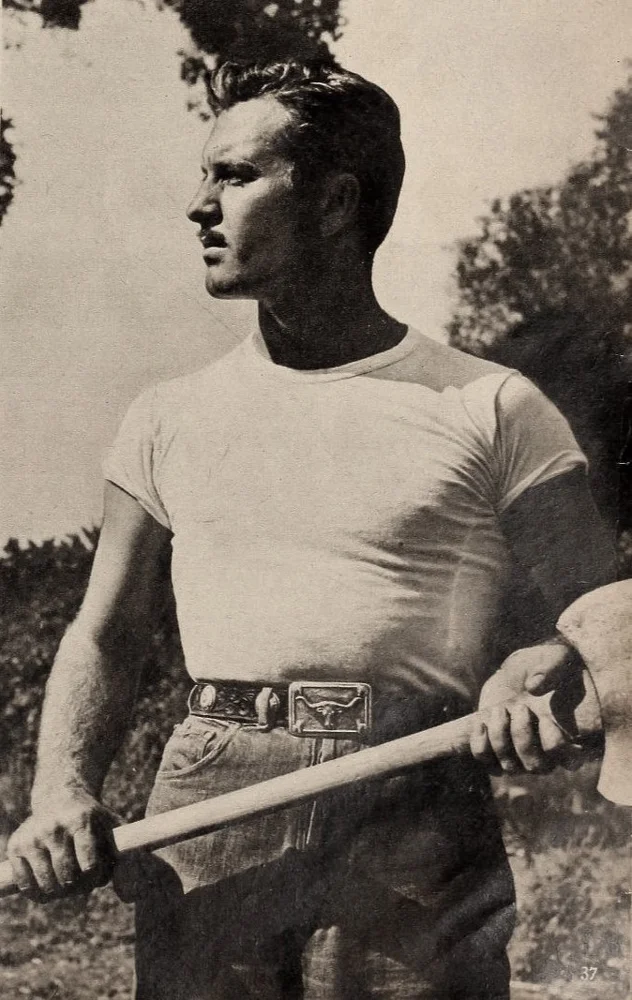
Modern Screen portrait (1943)
Magazine portrait of George Montgomery
Photographer uncredited. The photograph appeared in the January 1944 issue; the archive dates the photograph to 1943.
Entry point: Cimarron City (Matthew Rockford).
Explore the career in pictures
Updated
George Montgomery was an American actor whose work connects studio-era musicals and romantic stories with the Western films and television for which he became especially well known. His career also included painting, sculpture and furniture making. Cimarron City's Matthew Rockford is one useful television entry point, but it does not represent the whole of his screen identity. A career survey can move from the bandstand world of Orchestra Wives to the troubled frontier town of Black Patch. Those settings ask different things of a leading man, and the contrast makes his body of work more interesting than a list of cowboy titles suggests.
Montgomery grew up in Montana as George Montgomery Letz. Ranch life gave him riding and cattle-handling experience, and he attended the University of Montana before heading to Hollywood. The Hollywood Walk of Fame's account traces early work at Republic Pictures, where he appeared in small parts and performed stunts under the name George Letz. Westerns with Gene Autry were part of that apprenticeship. At 20th Century Fox he was billed as George Montgomery and moved into more prominent assignments. The transition connected practical physical skills with the studio's work of developing a recognizable leading performer.
Cimarron City brought Montgomery to a continuing television Western role as Matthew Rockford. The 1958 NBC publicity photograph reproduced here pairs him with guest performer Fred MacMurray. That distinction matters: the photograph records a particular television collaboration, rather than establishing MacMurray as a regular partner throughout Montgomery's career. A useful viewing approach is to compare the series' recurring community with the more self-contained conflicts of his feature Westerns. The television setting can return to familiar relationships, while a film must introduce and resolve its central pressures within a single story.
In Orchestra Wives, Montgomery plays Bill Abbott, a trumpet player whose marriage to Ann Rutherford's Connie Ward is strained by life around a touring band. Glenn Miller appears as bandleader Gene Morrison, and Lynn Bari plays the band's singer. The 1942 film combines musical attractions with the personal tensions surrounding the musicians. Montgomery's job is to make the romance and misunderstandings hold attention between numbers. For a viewer accustomed to seeing him in Western dress, the contemporary musical setting is a useful corrective: his studio career included stories whose central problem was sustaining a relationship rather than confronting an outlaw.
Black Patch casts Montgomery as Marshal Clay Morgan, with Diane Brewster as Helen Danner and Leo Gordon as Hank Danner. The 1957 Western places an old personal connection inside a lawman's present responsibilities. TCM describes Morgan as a veteran who has lost an eye and carries emotional wounds, and identifies Gordon as the screenplay's writer as well as a performer. Instead of treating the eye patch as the whole characterization, watch how the prior relationship complicates a public duty. The film gives a familiar Western star a more troubled position than an uncomplicated hero arriving to set a town right.
Montgomery's later life gave increasing space to work outside acting. ClassicFlix documents his longstanding woodworking interest and his development as a painter and sculptor, along with a 1991 Autry exhibition of his art and furniture. His book The Years of George Montgomery appeared in 1981. These were continuing creative pursuits, not just props or skills belonging to his screen characters. The distinction helps explain why an account limited to film credits is incomplete. The gallery's Montana photograph supplies a separate public context, while the publicity images show how the entertainment industry presented him at different points.
Begin with Orchestra Wives and Black Patch for a compact comparison, then sample Cimarron City to see how Montgomery works in a recurring television setting. Other useful stops include his Philip Marlowe in The Brasher Doubloon and his musical work in Three Little Girls in Blue. The three gallery selections are deliberately identified by their real contexts: a magazine portrait, television publicity and a Montana photograph from a family collection. They are not presented as scenes from films they do not depict. Together they provide a visual route through a career that included both screen performance and sustained craftsmanship.
Magazine portraiture, television publicity and a Montana appearance document different contexts in Montgomery's career. Select an image for a larger view.
Magazine portrait of George Montgomery
Photographer uncredited. The photograph appeared in the January 1944 issue; the archive dates the photograph to 1943.
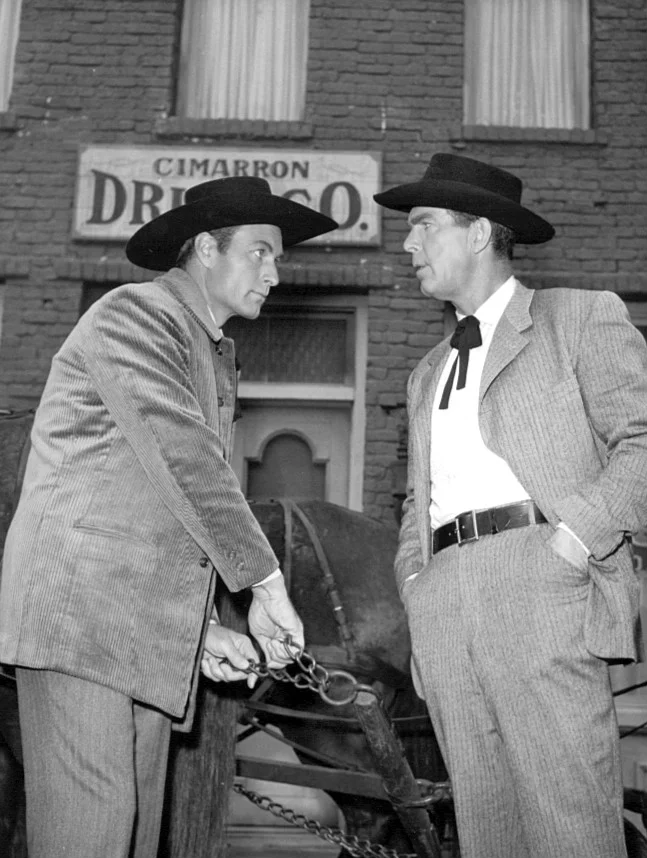
Matthew Rockford with guest star Fred MacMurray
NBC publicity photograph dated September 19, 1958. MacMurray is identified as a guest performer.
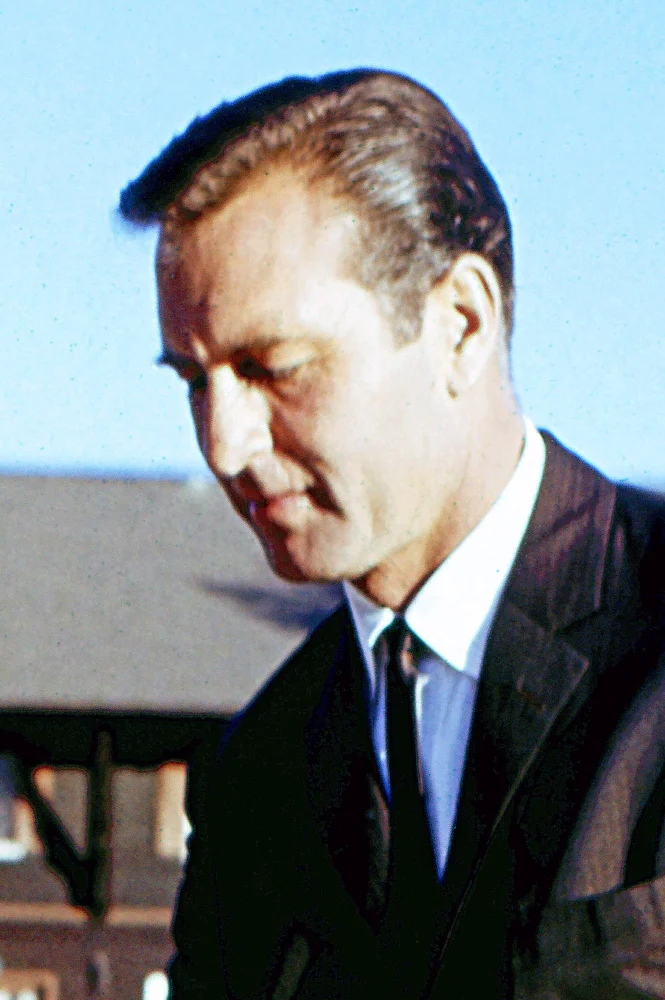
Photograph by Ben Jamison
Family collection photograph. The archive is uncertain about the precise convention; this caption does not assert one.
Hollywood Walk of Fame: early career
https://walkoffame.com/george-montgomery/
TCM: Orchestra Wives
https://www.tcm.com/articles/536430/orchestra-wives-1942-orchestra-wives
AFI: Black Patch cast
https://catalog.afi.com/Film/52110-BLACK-PATCH
TCM: Western Wednesday and Black Patch
https://www.tcm.com/articles/59883/western-wednesday
ClassicFlix: career and art
https://www.classicflix.com/blog/2014/05/05/george-montgomery-actor-artist-renaissance-man
Los Angeles Times: career remembrance
https://projects.latimes.com/hollywood/star-walk/george-montgomery/
Commons: portrait provenance and license
https://commons.wikimedia.org/wiki/File:George_Montgomery_-_still.jpg
Corrections: hello@dailytimecapsule.com
Work: George_Montgomery_-_still.jpg
Creator: 20th Century Fox
Date: 1943
Original source: https://commons.wikimedia.org/wiki/File:George_Montgomery_-_still.jpg
Primary archive: https://commons.wikimedia.org/wiki/File:George_Montgomery_-_still.jpg
License: Public domain in the United States: published without copyright notice
License URI: https://commons.wikimedia.org/wiki/Template:PD-US-no_notice
Changes: Existing Commons crop retained; resized and converted to WebP; share image adds title and framing.
Rights scope: No endorsement implied. See the stated license and modification notice.
Work: George_Montgomery,_1943.jpg
Creator: Photographer uncredited / Modern Screen
Date: 1943; published January 1944
Original source: https://commons.wikimedia.org/wiki/File:George_Montgomery%2C_1943.jpg
Primary archive: https://commons.wikimedia.org/wiki/File:George_Montgomery%2C_1943.jpg
License: Public domain in the United States: copyright not renewed
License URI: https://commons.wikimedia.org/wiki/Template:PD-US-not_renewed
Changes: Existing magazine crop retained; resized and converted to WebP.
Rights scope: No endorsement implied. See the stated license and modification notice.
Work: George_Montgomery_Fred_MacMurray_Cimarron_City_1958.jpg
Creator: NBC Television
Date: 19 September 1958
Original source: https://commons.wikimedia.org/wiki/File:George_Montgomery_Fred_MacMurray_Cimarron_City_1958.jpg
Primary archive: https://commons.wikimedia.org/wiki/File:George_Montgomery_Fred_MacMurray_Cimarron_City_1958.jpg
License: Public domain in the United States: published without copyright notice
License URI: https://commons.wikimedia.org/wiki/Template:PD-US-no_notice
Changes: Existing Commons crop retained; resized and converted to WebP.
Rights scope: No endorsement implied. See the stated license and modification notice.
Work: 1960_george_montgomery.jpg
Creator: Ben Jamison; family collection shared by FranksValli
Date: 1960
Original source: https://commons.wikimedia.org/wiki/File:1960_george_montgomery.jpg
Primary archive: https://commons.wikimedia.org/wiki/File:1960_george_montgomery.jpg
License: Released into the public domain by the rights holder
License URI: https://commons.wikimedia.org/wiki/Template:PD-self
Changes: Resized and converted to WebP.
Rights scope: No endorsement implied. See the stated license and modification notice.