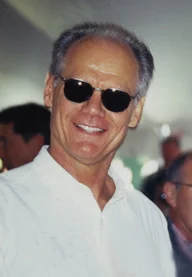
Earlier public appearance (Before April 2007)
Fred Dryer
Howdythere’s photograph was uploaded in April 2007; its capture date is not documented.
Entry point: Hunter (1984–1991).
Explore the career in pictures
Updated
Fred Dryer brought an established professional sports career into television, becoming best known on screen as Detective Rick Hunter. The transition gave him two distinct public identities: a defensive end remembered by football audiences and the lead of a long-running crime series. Hunter is the clearest starting point for his acting work, but it gains context from the years of disciplined physical performance that preceded it.
Dryer played college football at El Camino and San Diego State before entering the National Football League. His professional career lasted thirteen seasons with the New York Giants and Los Angeles Rams. The National Football Foundation inducted him into the College Football Hall of Fame in 1997. Those achievements belong to his sporting career; they help explain his public visibility before acting without substituting for the separate demands of screen performance.
Hunter ran from 1984 to 1991, with Dryer as Rick Hunter and Stepfanie Kramer as Dee Dee McCall for much of its run. The detective partnership placed action sequences alongside investigations and recurring workplace relationships. Dryer’s size and physical confidence were obvious assets, but a weekly series also required an identifiable rhythm in conversation. Viewers returned for the partnership and personalities as well as the individual case.
His performance often uses a direct line of attention and an unhurried response to hold a scene. A useful rewatch compares the pace of an action sequence with the exchanges that follow it. The character’s confidence can remain consistent even as the setting changes from a confrontation to an office conversation. That continuity helps make the detective recognizable across stories written and directed by different people.
Dryer’s other screen work includes appearances in Cheers, the action film Death Before Dishonor and the series Land’s End. These credits offer opportunities to compare the familiar Hunter persona with different comic and dramatic circumstances. A guest appearance has less time to establish a character than a continuing lead role, while a feature film organizes its action toward a different kind of conclusion.
He also moved into radio, including The Fred Dryer Show. That work places greater emphasis on voice and conversation, giving audiences another setting in which to encounter a performer first known for physical competition. The progression from football to scripted television and broadcasting is not a single uninterrupted role. Each medium changes what an audience can see, hear and expect from the person addressing it.
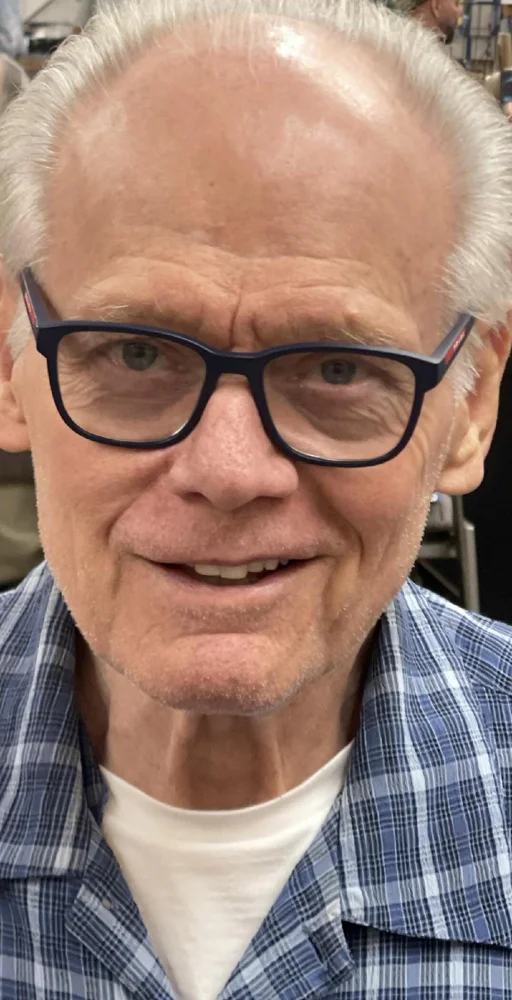
The gallery pairs an older public-appearance photograph, uploaded in 2007 without a documented capture date, with a 2025 convention portrait. They are separate images of Dryer rather than pictures of Rick Hunter. The difference matters when looking back across a long career: the familiar television character is a sustained performance, while these photographs record the person whose work has reached audiences through sport, drama and conversation.
Two distinct public-appearance photographs, with the older image’s date uncertainty retained.
Fred Dryer
Howdythere’s photograph was uploaded in April 2007; its capture date is not documented.
Fred Dryer
John Mathew Smith photographed Dryer on September 20, 2025; this is the archive’s cropped version.
National Football Foundation: Fred Dryer
https://footballfoundation.org/hof_search.aspx?hof=1922
KABC: The Fred Dryer Show biography
https://www.kabc.com/freddryershow/
Fred Dryer: career chronology
https://en.wikipedia.org/wiki/Fred_Dryer
Hunter: series history
https://en.wikipedia.org/wiki/Hunter_(1984_American_TV_series)
Commons: portrait provenance and license
https://commons.wikimedia.org/wiki/File:Fred%20Dryer%20%28cropped%29.jpg
Corrections: hello@dailytimecapsule.com
Work: Fred Dryer (cropped).jpg
Creator: John Mathew Smith & www.celebrity-photos.com
Date: 2025-09-20
Original source: https://commons.wikimedia.org/wiki/File:Fred%20Dryer%20%28cropped%29.jpg
Primary archive: https://commons.wikimedia.org/wiki/File:Fred%20Dryer%20%28cropped%29.jpg
License: CC BY-SA 4.0
License URI: https://creativecommons.org/licenses/by-sa/4.0
Changes: Resized and converted to WebP; portrait/share may be cropped. Adaptations remain under CC BY-SA 4.0.
Rights scope: No endorsement implied. See the stated license and modification notice.
Work: Dryerhof.jpg
Creator: Howdythere at English Wikipedia
Date: Taken before upload on April 26, 2007; capture date not documented
Original source: https://commons.wikimedia.org/wiki/File:Dryerhof.jpg
Primary archive: https://commons.wikimedia.org/wiki/File:Dryerhof.jpg
License: Public domain
License URI: https://commons.wikimedia.org/wiki/Template:PD-user
Changes: Resized and converted to WebP; portrait/share may be cropped. No endorsement implied.
Rights scope: No endorsement implied. See the stated license and modification notice.