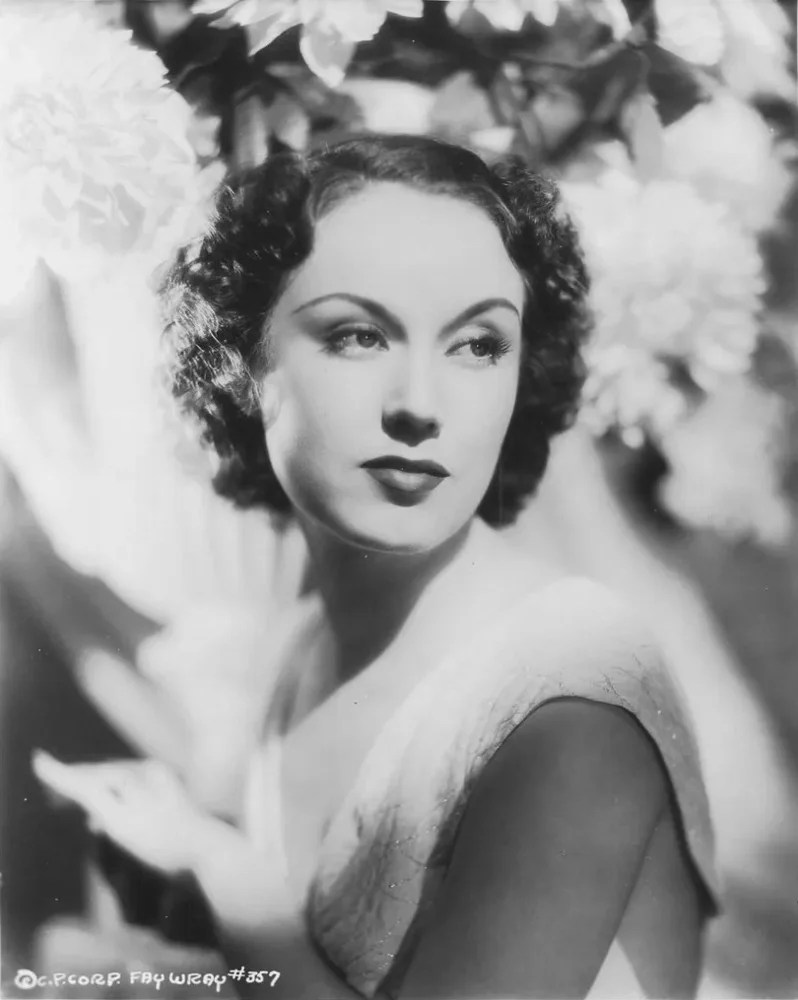
Fay Wray studio portrait (1930)
Portrait by Whitey Schafer
Archive portrait credited to Whitey Schafer; the source dates it to 1930.
Entry point: King Kong (Ann Darrow).
Explore the career in pictures
Updated
Fay Wray's place in film history is inseparable from King Kong, but the path to Ann Darrow began in silent cinema and continued well beyond the 1933 fantasy. She worked in comedy, westerns, romantic melodrama and suspense before becoming one of the most recognisable faces associated with screen horror. Looking across those films restores a fuller career to a performer too often represented by a single image. Her work links the expressive demands of silent filmmaking with the voices and sounds of early Hollywood talkies.
Born in Cardston, Alberta, in 1907, Wray entered film work as a teenager after moving to Los Angeles. TCM's profile traces early employment at Hal Roach and Universal, where her assignments crossed several genres. Selection among the WAMPAS Baby Stars in 1926 marked her as a promising newcomer. The significant artistic opportunity was Erich von Stroheim's The Wedding March, in which she played Mitzi opposite the director himself. That collaboration gave her emotional scenes and sustained dramatic attention beyond decorative supporting appearances.
The Wedding March places Mitzi in a romance constrained by class and money in pre-war Vienna. Von Stroheim's aristocratic character is expected to marry wealth, while his attraction to Mitzi points elsewhere. TCM's account draws attention to the exchanges of looks during the ceremonial procession: close-ups and gestures carry the relationship before explanations can. It is a useful entry point into Wray's silent acting. Watch how a reaction becomes part of the conversation, and how the surrounding spectacle frames the more private encounter between two people.
In The Most Dangerous Game, released in 1932, Wray plays Eve Trowbridge opposite Joel McCrea's Bob Rainsford and Leslie Banks's Zaroff. The island adventure turns hospitality into a threat as the host reveals a taste for hunting human prey. Directed by Ernest B. Schoedsack and Irving Pichel, it adapted Richard Connell's story. Wray supplies an essential partner to McCrea within its suspense. The film deserves attention as a compact thriller in its own right, even though its production connections to King Kong are unusually close.
Criterion's production essay describes how Wray, Robert Armstrong and Noble Johnson participated in the test work that helped bring King Kong forward, using the earlier film's set. In the completed fantasy, Ann's journey carries her from a filmmaking expedition to the danger of Skull Island and then New York. The Library of Congress catalogue preserves that narrative progression from discovery to capture and spectacle. Wray's human presence is central to the contrast of scales: the audience must read fear, surprise and vulnerability against the extraordinary creature around her.
Wray's later career included television appearances on Alfred Hitchcock Presents, Perry Mason, Wagon Train, Hawaiian Eye and 77 Sunset Strip. TCM identifies Gideon's Trumpet in 1980 among her final screen work. She also revisited her career in the memoir On the Other Hand, a valuable reminder that the performer had her own perspective on the fame of Kong. The continued interest in that film brought later generations to her work, but the guest roles and earlier pictures show an actress whose professional life extended across changing production systems.
For a broader rewatch, place The Wedding March beside The Most Dangerous Game and King Kong. The three films offer romance, pursuit and fantasy, with different demands on the same performer. Notice the difference between a held look in a silent scene and a spoken warning in a sound thriller. The gallery pairs a studio portrait dated 1930 with an archive photograph of Wray and von Stroheim associated with The Wedding March. It preserves the individual credits and dates rather than treating every image of her as a Kong publicity photograph.
A studio portrait and a separate production photograph document Wray beyond her best-known fantasy role.
Portrait by Whitey Schafer
Archive portrait credited to Whitey Schafer; the source dates it to 1930.
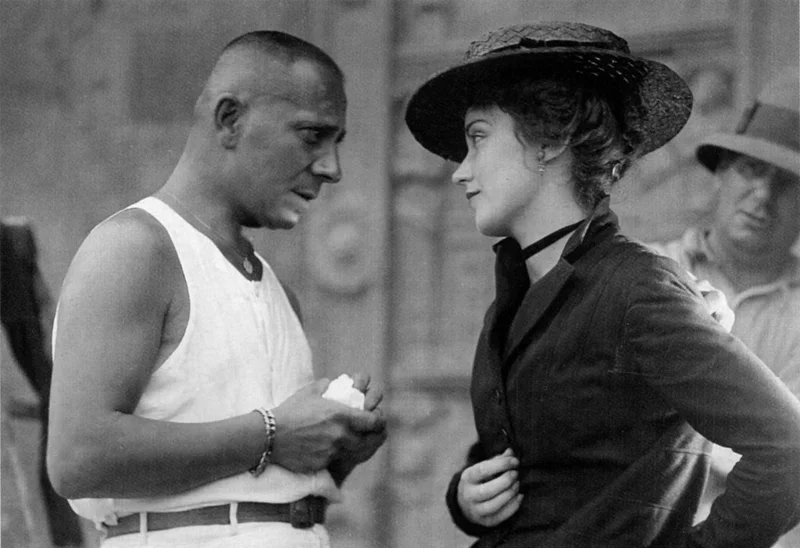
Silent-film collaboration
The archive identifies Wray and Erich von Stroheim together on the production.
TCM: Fay Wray profile
https://www.tcm.com/articles/176193/fay-wray-profile
TCM: The Wedding March
https://www.tcm.com/articles/1230160/the-wedding-march
Criterion: The Most Dangerous Game
https://www.criterion.com/films/584-the-most-dangerous-game
Criterion essay by Bruce Kawin
https://www.criterion.com/current/posts/52-the-most-dangerous-game
Library of Congress: King Kong
https://www.loc.gov/item/89716156/
TCM career retrospective
https://www.tcm.com/articles/1230152/fay-wray-8-4
Commons: portrait provenance and license
https://commons.wikimedia.org/wiki/File:Fay%20Wray%20by%20A.%20L.%20Whitey%20Schafer.jpg
Corrections: hello@dailytimecapsule.com
Work: Fay Wray by A. L. Whitey Schafer.jpg
Creator: Whitey Schafer
Date: 1930
Original source: https://commons.wikimedia.org/wiki/File:Fay%20Wray%20by%20A.%20L.%20Whitey%20Schafer.jpg
Primary archive: https://commons.wikimedia.org/wiki/File:Fay%20Wray%20by%20A.%20L.%20Whitey%20Schafer.jpg
License: Public domain
License URI: https://commons.wikimedia.org/wiki/File:Fay_Wray_by_A._L._Whitey_Schafer.jpg
Changes: Resized and converted to WebP; portrait also placed in a titled share image. No endorsement implied.
Rights scope: No endorsement implied. See the stated license and modification notice.
Work: Fay Wray and Erich von Stroheim on the set of the film The Wedding March, 1928.jpg
Creator: Paramount Pictures, 1928
Date: 1928
Original source: https://commons.wikimedia.org/wiki/File:Fay%20Wray%20and%20Erich%20von%20Stroheim%20on%20the%20set%20of%20the%20film%20The%20Wedding%20March%2C%201928.jpg
Primary archive: https://commons.wikimedia.org/wiki/File:Fay%20Wray%20and%20Erich%20von%20Stroheim%20on%20the%20set%20of%20the%20film%20The%20Wedding%20March%2C%201928.jpg
License: Public domain
License URI: https://commons.wikimedia.org/wiki/File:Fay_Wray_and_Erich_von_Stroheim_on_the_set_of_the_film_The_Wedding_March%2C_1928.jpg
Changes: Resized and converted to WebP; portrait also placed in a titled share image. No endorsement implied.
Rights scope: No endorsement implied. See the stated license and modification notice.