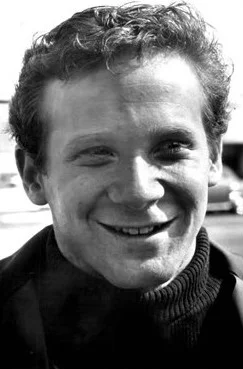
Happy Days advance publicity (1973)
Ralph Malph
Portrait released in December 1973, before the series premiered.
Entry point: Happy Days (1974).
Explore the career in pictures
Updated
Don Most is an American actor, singer and director best known as Ralph Malph in Happy Days. Also credited as Donny Most, he grew up in Brooklyn and pursued performance while still young. His career combines television comedy with film appearances, directing and live music. The variety is important to understanding him: the jokester in the Milwaukee friendship group became his most recognizable character, but singing preceded that role and remained a substantial part of his later professional identity.
Most's official biography describes a childhood enthusiasm for The Jolson Story and training in acting, singing and dancing. As a teenager he performed in a musical revue in the Catskills. That background makes his later work as a vocalist less of a departure than it might seem to viewers who encountered him only through sitcoms. His early ambitions involved an entertainer's range of skills, with musical performance and acting developing together before the television opportunity that introduced him to a national audience.
In Happy Days, Ralph Malph was part of Richie Cunningham's circle alongside Potsie Weber and Fonzie. Most worked with Ron Howard, Anson Williams and Henry Winkler in an ensemble whose jokes depended on differences between the young men's temperaments. Ralph often sought the laugh himself, making the distinction between the character's attempted joke and the audience's reaction part of the comedy. The series began in 1974; Most was a regular through 1980 and later returned as a guest. His participation should not be confused with the show's entire run.
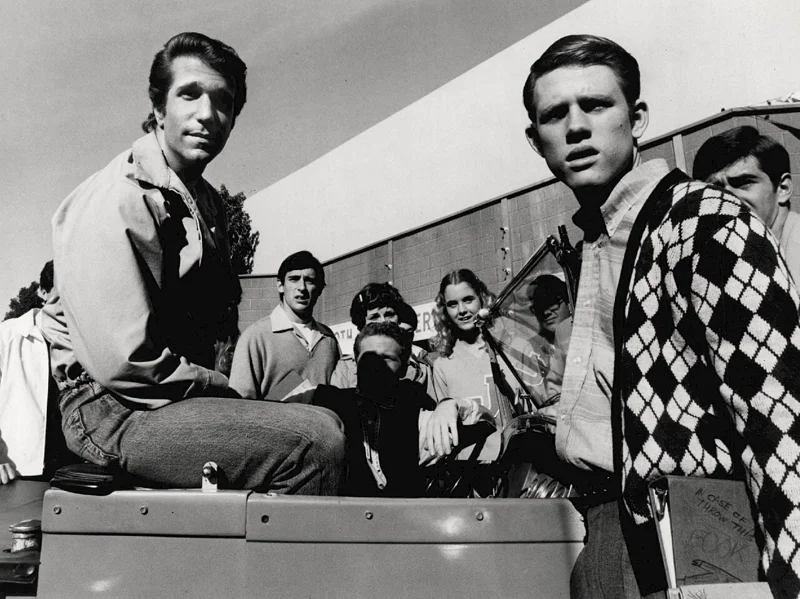
The two publicity images here belong to that early Happy Days period. One is a portrait released in December 1973, before the series began broadcasting; the other is a 1974 ensemble photograph involving Ralph's car. They are separate original photographs, not two crops of the same picture. Looking at the portrait alongside the group image shows the difference between presenting an individual cast member and advertising a comic situation. Neither photograph is evidence for a later film, musical engagement or directing project.
After his regular sitcom years, Most accumulated film and television appearances across several genres. His film credits include Crazy Mama, EDtv and The Great Buck Howard. EDtv also connects him professionally with Ron Howard, this time as a director rather than as the actor playing Richie. His later television work includes a recurring appearance in Glee and guest roles in programmes such as Star Trek: Voyager. These credits show continued ensemble work beyond the familiar sitcom setting without implying that each appearance was a leading role.
Most also moved behind the camera, directing features including The Last Best Sunday, Moola and Harley's Hill. His musical work has drawn on swing and big-band standards, with performances associated with singers such as Frank Sinatra, Bobby Darin and Dean Martin. The Grand Ole Opry and Summit Records artist pages document this musical side of his career. For listeners approaching it through nostalgia for Happy Days, the arrangements and vocal phrasing offer a different way to encounter the performer, apart from Ralph's comic delivery.
A useful introduction to Most's career pairs an early Happy Days episode with a later film appearance and a musical performance. That sequence preserves the role that made him famous while leaving room for work that uses other skills. This guide selects representative milestones rather than presenting an exhaustive catalogue. The gallery remains focused on accurately dated early television photographs; the wider biography follows his subsequent acting, directing and singing without attaching unrelated production claims to those images. His different professional activities are connected by performance, but each has its own history.
Two distinct early Happy Days publicity photographs, released in 1973 and 1974.
Ralph Malph
Portrait released in December 1973, before the series premiered.
Ralph Malph
Most with Henry Winkler and Ron Howard in publicity involving Ralph's car.
Official biography
https://realdonmost.com/about-don
Opry artist biography
https://www.opry.com/artists/donny-most
Summit Records artist biography
https://summitrecords.com/artist/donny-most/
Career and filmography
https://en.wikipedia.org/wiki/Don_Most
Commons: portrait provenance and license
https://commons.wikimedia.org/wiki/File:Donnie%20Most%20Ralph%20Malph%201973.jpg
Corrections: hello@dailytimecapsule.com
Work: Donnie Most Ralph Malph 1973.jpg
Creator: ABC Television
Date: 1973-12-18
Original source: https://commons.wikimedia.org/wiki/File:Donnie%20Most%20Ralph%20Malph%201973.jpg
Primary archive: https://commons.wikimedia.org/wiki/File:Donnie%20Most%20Ralph%20Malph%201973.jpg
License: Public domain
License URI: https://commons.wikimedia.org/wiki/File:Donnie_Most_Ralph_Malph_1973.jpg
Changes: Resized and converted to WebP; portrait also placed in a titled share image. No endorsement implied.
Rights scope: No endorsement implied. See the stated license and modification notice.
Work: Happy Days 1974.jpg
Creator: ABC Television
Date: 1974-05-21
Original source: https://commons.wikimedia.org/wiki/File:Happy%20Days%201974.jpg
Primary archive: https://commons.wikimedia.org/wiki/File:Happy%20Days%201974.jpg
License: Public domain
License URI: https://commons.wikimedia.org/wiki/File:Happy_Days_1974.jpg
Changes: Resized and converted to WebP; portrait also placed in a titled share image. No endorsement implied.
Rights scope: No endorsement implied. See the stated license and modification notice.