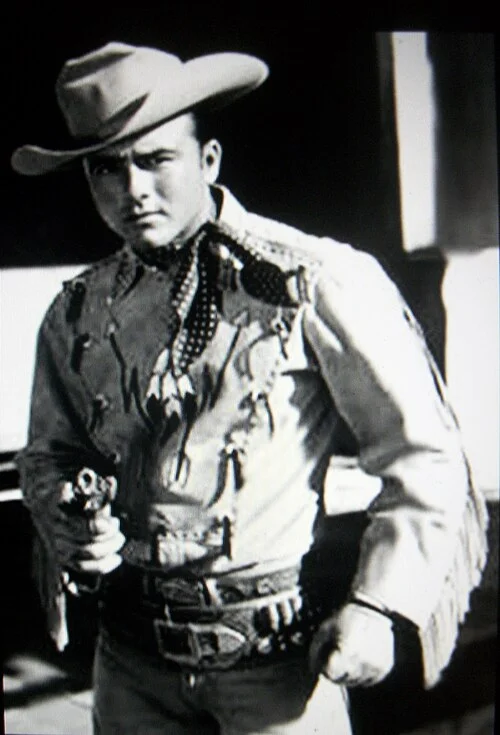
Buffalo Bill, Jr. (1955)
Buffalo Bill, Jr.
Publicity portrait of Jones in the television western; source credits Flying A provisionally.
Entry point: Pinocchio (1940).
Explore the career in pictures
Updated
Dickie Jones, also billed as Dick Jones, joined childhood film acting and voice performance to a later career in television westerns. Born in McKinney, Texas, on February 25, 1927, he became the voice of the wooden puppet in Disney's Pinocchio. The name on that animated classic belongs to the same performer later seen with Jock Mahoney in The Range Rider and starring in Buffalo Bill, Jr. Those credits reveal an unusually varied working life: microphone acting, youthful supporting film parts, action performance and a western series built around him.
Disney's biographical record describes a child already experienced in motion pictures when he was selected for Pinocchio. His early credits included Stella Dallas, Wonder Bar and Daniel Boone. Western performer Hoot Gibson helped encourage the family's move toward Hollywood, and Jones worked with several cowboy stars while still young. That background is useful when considering his later television career. Western work was not simply a new direction adopted after voice acting; it was present in the circumstances and screen experience that preceded his best-known Disney role.
Pinocchio premiered in New York on February 7, 1940. Jones supplied the title character's voice, with Cliff Edwards as Jiminy Cricket, Christian Rub as Geppetto and Evelyn Venable as the Blue Fairy. The story makes the puppet's developing judgment and susceptibility to temptation central to his journey toward becoming a real boy. Jones's contribution was vocal, but Disney also records his participation in live-action reference studies for the animators. His performance therefore belongs to a collaborative production process, not to a live-action portrayal of the finished animated character.
His work during this period extended beyond the recording studio. In Frank Capra's Mr. Smith Goes to Washington, released in 1939, the American Film Institute identifies Jones as a page boy in the large cast surrounding James Stewart's Jefferson Smith. It was a supporting assignment in a political comedy-drama, distinct from his title-character voice work. AFI's filmography also records his appearance as the Claggett boy in Destry Rides Again that year. These credits place the young actor in ordinary feature-film production at the same time that animation was creating the role most closely associated with his name.
Radio supplied another important youthful character. Jones played Henry Aldrich during the wartime period when several actors filled the role associated with Ezra Stone. The CBS publicity photograph dated November 1944 shows Jones at left with Katherine Raht as Mrs. Aldrich and House Jameson as Mr. Aldrich, gathered at a microphone with scripts. It documents a radio family, not the cast of a later television version. The image also makes a useful counterpart to the western portrait: the same actor could create a character through timing and voice without the costume and physical action required on screen.
In the 1950 feature Rocky Mountain, directed by William Keighley, Jones played Jimmy Wheat alongside Errol Flynn's Lafe Barstow. Television then gave him recurring western work through Gene Autry's production organization. He appeared with Jock Mahoney in The Range Rider before leading Buffalo Bill, Jr. A March 24, 1955 newspaper announcement identifies Jones as the new series' star, with Nancy Gilbert as his younger sister Calamity and Harry Cheshire in support. The production guide identifies Cheshire's character as Judge Ben Wiley. These are characters in a television adventure, not evidence that Jones portrayed a documentary account of the historical Cody family.
Buffalo Bill, Jr. was produced through Flying A and ran in the mid-1950s, giving Jones a title role on camera as well as his earlier one behind a microphone. His later life included work in real estate, and Disney honored him as a Legend in the voice category in 2000. The two photographs here preserve different parts of that career: a western publicity portrait and an identified radio ensemble. Keeping those contexts visible helps reconnect the recognizable animated voice with the actor's face and with the other professional work that surrounded it.
A western publicity portrait and a separate CBS radio ensemble photograph show two distinct parts of Jones’s career.
Buffalo Bill, Jr.
Publicity portrait of Jones in the television western; source credits Flying A provisionally.
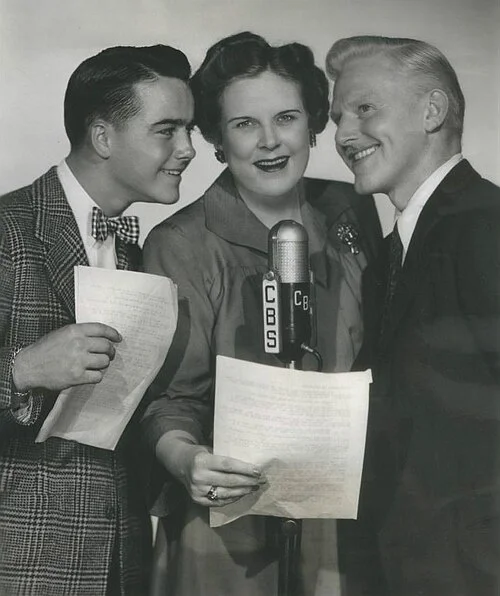
Henry Aldrich
From left: Jones, Katherine Raht and House Jameson. CBS radio publicity dated November 1944.
Disney Legend Dick Jones
https://d23.com/walt-disney-legend/dick-jones/
Pinocchio premiere
https://d23.com/this-day/pinocchio-premiered/
Mr. Smith Goes to Washington
https://catalog.afi.com/Film/6445-MR-SMITH-GOES-TO-WASHINGTON
Rocky Mountain
https://catalog.afi.com/Film/26476-ROCKY-MOUNTAIN
The Aldrich Family casting history
https://store.radiospirits.com/blog/happy-birthday-ezra-stone/
Buffalo Bill Jr contemporary announcement
https://pioneertownsun.com/buffalo-bill-jr-in-television-debut/
Buffalo Bill Jr production guide
https://ctva.biz/US/Western/BuffaloBillJr.htm
Commons: portrait provenance and license
https://commons.wikimedia.org/wiki/File:Buffalo%20Bill%20Jr.jpg
Corrections: hello@dailytimecapsule.com
Work: Buffalo Bill Jr.jpg
Creator: Believed to be created by Flying A Productions.
Date: 1955
Original source: https://commons.wikimedia.org/wiki/File:Buffalo%20Bill%20Jr.jpg
Primary archive: https://commons.wikimedia.org/wiki/File:Buffalo%20Bill%20Jr.jpg
License: Public domain
License URI: https://commons.wikimedia.org/wiki/File:Buffalo_Bill_Jr.jpg
Changes: Resized and converted to WebP; portrait also placed in a titled share image. No endorsement implied.
Rights scope: No endorsement implied. See the stated license and modification notice.
Work: Dick Jones Katherine Raht House Jameson Aldrich Family 1944.JPG
Creator: Columbia Broadcasting-CBS
Date: 1944-11
Original source: https://commons.wikimedia.org/wiki/File:Dick%20Jones%20Katherine%20Raht%20House%20Jameson%20Aldrich%20Family%201944.JPG
Primary archive: https://commons.wikimedia.org/wiki/File:Dick%20Jones%20Katherine%20Raht%20House%20Jameson%20Aldrich%20Family%201944.JPG
License: Public domain
License URI: https://commons.wikimedia.org/wiki/File:Dick_Jones_Katherine_Raht_House_Jameson_Aldrich_Family_1944.JPG
Changes: Resized and converted to WebP; portrait also placed in a titled share image. No endorsement implied.
Rights scope: No endorsement implied. See the stated license and modification notice.