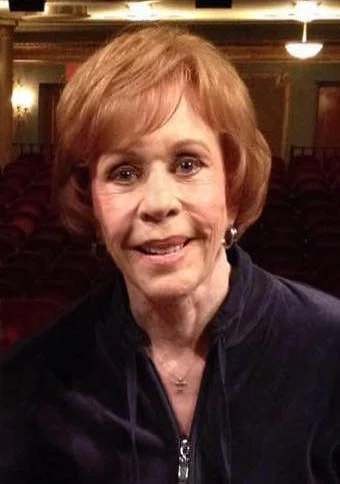
Theater portrait (2014)
Carol Burnett in a theater setting
Photograph by Dennis115; the performer rather than a sketch character.
Entry point: The Carol Burnett Show (1967–1978).
Explore the career in pictures
Updated
Carol Burnett built a career across musical theater, television comedy and dramatic acting, with The Carol Burnett Show becoming the central public expression of her range. Her performances could be physically extravagant or almost conversational, sometimes moving between those modes within a single sketch. The variety format made that flexibility visible: a host addressing an audience could soon become an entirely different person in a costume, a musical number or a parody. Burnett's work is especially rewarding when viewed as both individual performance and sustained collaboration with an ensemble.
In 1959, Burnett reached Broadway in Once Upon a Mattress and became a regular on The Garry Moore Show. The stage musical gave her Princess Winnifred, a role requiring comic energy as well as singing, while television placed her within a continuing variety company. These were complementary forms of experience. A musical performer must carry a character through song and movement; a television comic must also respond to the camera's more intimate scale. Burnett's later work draws on both, allowing a large gesture to resolve into a precise look that the viewer catches at close range.
The Carol Burnett Show ran from 1967 to 1978, combining sketches, musical performances, guests and direct interaction with the studio audience. Its familiar company included Harvey Korman, Vicki Lawrence, Lyle Waggoner and, during the run, Tim Conway. The cast changed over time, so a photograph from one year should not be mistaken for a complete record of every season. What remained central was the interplay between performers. Burnett could lead a scene forcefully while still leaving space for a partner's timing to redirect it or make an apparently ordinary exchange unexpectedly funny.
The charwoman pictured in the gallery is one of Burnett's distinctive comic creations. The costume establishes a social position and an outward appearance, but her face and posture supply the emotional life. The 1974 publicity portrait captures a reflective expression rather than a broad punchline. It is a useful reminder that comic characters need more than a funny silhouette. Burnett can invite sympathy without abandoning the joke, allowing a figure who might otherwise be treated as a visual gag to suggest curiosity, disappointment or a private imaginative world.
A close viewing of the variety show also reveals how much preparation sits behind its apparent spontaneity. Sets, costumes, songs and scripted situations give the performers a structure in which timing can remain alive. Burnett's Television Academy interview is a substantial record of her own account of that career, while the archive's interviews with colleagues provide additional perspectives on the work. Rather than assuming every laugh came from an accident, it is worth noticing the transitions, the clear setup of a situation and the way the ensemble makes a comic escalation understandable.
Burnett's career continued beyond the original variety series, and later honors recognized a body of work that had shaped American comedy. She entered the Television Academy Hall of Fame in 1985 and received the Kennedy Center's Mark Twain Prize in 2013. These honors provide useful historical markers, but they are not substitutes for watching the performances. The gallery's 2014 portrait, photographed in a theater setting, offers a later view of the performer alongside the earlier character image. The two photographs document different decades and different relationships between an actor and an audience.
An introduction to Burnett can begin with a musical appearance, move to a charwoman sketch and then compare one of the variety show's ensemble scenes. Each asks for a different distribution of attention. Sometimes she carries the whole moment; sometimes the most effective choice is to listen or let another performer finish the comic turn. That generosity is part of the work's continuing appeal. Her legacy rests on a combination of vocal ability, physical imagination and responsiveness that made a long-running television format feel personal to the people watching it.
A 2014 theater portrait and a 1974 publicity photograph of Burnett’s charwoman character.
Carol Burnett in a theater setting
Photograph by Dennis115; the performer rather than a sketch character.
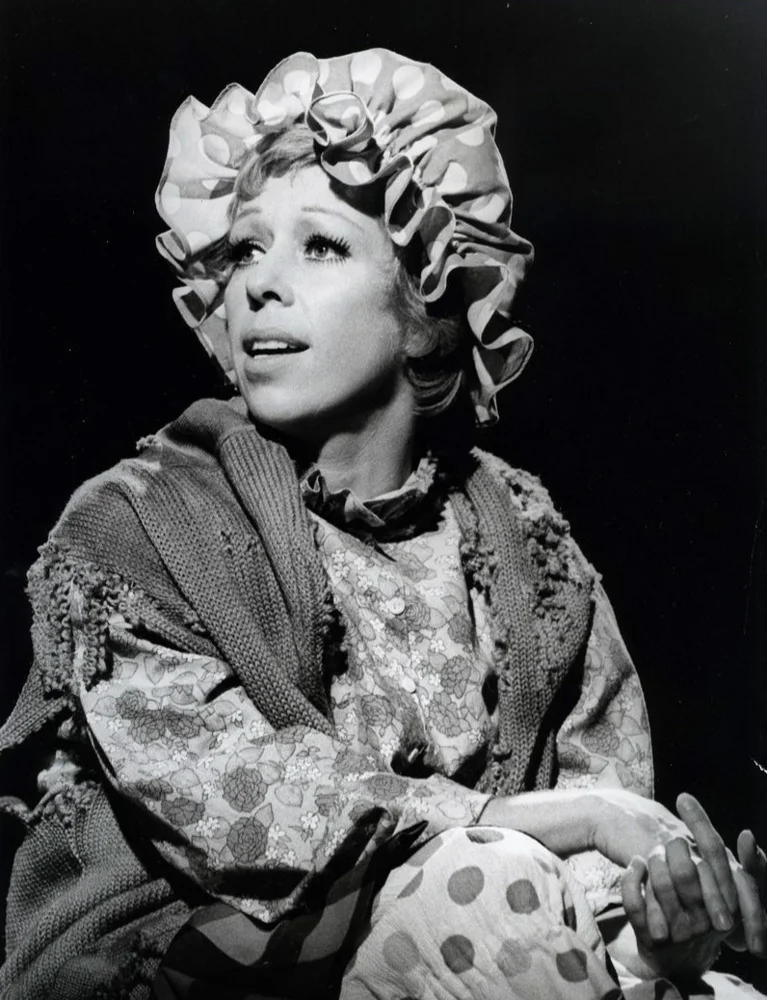
Carol Burnett in her charwoman character
CBS Television publicity photograph for The Carol Burnett Show.
Television Academy: Hall of Fame tribute
https://www.televisionacademy.com/features/news/hall-fame/carol-burnett-hall-fame-tribute
Television Academy: Carol Burnett interview
https://interviews.televisionacademy.com/interviews/carol-burnett
PBS: Pioneers of Television
https://www.pbs.org/wnet/pioneers-of-television/pioneering-people/carol-burnett/
California Museum: Carol Burnett
https://californiamuseum.org/inductee/carol-burnett/
PBS: 2013 Mark Twain Prize
https://www.pbs.org/video/mark-twain-prize-carol-burnett-kennedy-center-mark-twain-prize/
Commons: portrait provenance and license
https://commons.wikimedia.org/wiki/File:Carol%20Burnett%202014.jpg
Corrections: hello@dailytimecapsule.com
Work: Carol Burnett 2014.jpg
Creator: Dennis115
Date: 2014-11
Original source: https://commons.wikimedia.org/wiki/File:Carol%20Burnett%202014.jpg
Primary archive: https://commons.wikimedia.org/wiki/File:Carol%20Burnett%202014.jpg
License: CC BY 3.0
License URI: https://creativecommons.org/licenses/by/3.0
Changes: Resized and converted to WebP; portrait also placed in a titled share image. No endorsement implied.
Rights scope: No endorsement implied. See the stated license and modification notice.
Work: Carol Burnett charwoman character 1974.JPG
Creator: CBS Television
Date: 1974-02-08
Original source: https://commons.wikimedia.org/wiki/File:Carol%20Burnett%20charwoman%20character%201974.JPG
Primary archive: https://commons.wikimedia.org/wiki/File:Carol%20Burnett%20charwoman%20character%201974.JPG
License: Public domain
License URI: https://commons.wikimedia.org/wiki/File:Carol_Burnett_charwoman_character_1974.JPG
Changes: Resized and converted to WebP; portrait also placed in a titled share image. No endorsement implied.
Rights scope: No endorsement implied. See the stated license and modification notice.