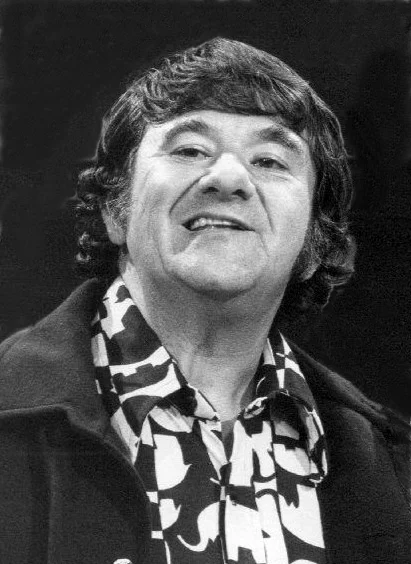
The Flip Wilson Show publicity (1973)
Buddy Hackett
NBC publicity photograph dated August 24, 1973.
Entry point: The Love Bug (1968).
Explore the career in pictures
Updated
Buddy Hackett was an American comedian and actor whose film roles include The Music Man, It’s a Mad, Mad, Mad, Mad World and The Love Bug. Animation audiences also know his voice as Scuttle in The Little Mermaid. His delivery could make a line feel as though a speaker had just found an unexpected route through it. A retrospective can follow that comic logic through live-action and voice work: the joke often depends on the distance between a character’s certainty and the audience’s growing recognition that something in the explanation has gone astray.
Born Leonard Hacker in Brooklyn in 1924, Hackett developed as a live entertainer before his familiar film and television work. Clubs and variety performance gave him an immediate relationship with an audience, where timing had to respond to actual laughter and attention. Those conditions differ from a feature film, but they help explain why a supporting appearance can feel self-contained and sharply shaped. A pause does not simply stop a sentence; it can invite an audience to anticipate a conclusion and then make the eventual continuation more surprising.
The Love Bug cast Hackett as Tennessee Steinmetz alongside Dean Jones and Michele Lee. Its comic world allows an extraordinary car to become part of an otherwise human group of ambitions, loyalties and misunderstandings. Hackett’s Tennessee helps make that world approachable through a different temperament from the leading driver’s. For a rewatch, notice how a supporting character’s response makes a fanciful premise easier to accept. The performer does not need to explain the whole story; a practical remark, a confident observation or an unhurried reaction can help establish its rules.
His earlier films included God’s Little Acre, The Music Man and It’s a Mad, Mad, Mad, Mad World. The last places him among a large group of comedians pursuing an increasingly chaotic objective. A crowded ensemble requires each performer to establish a recognizable rhythm without making every scene operate like a separate solo act. Compare a brief exchange with one of the larger set pieces. Hackett’s distinctive voice and reactions supply continuity even when the action changes scale, while the comedy still depends on the other performers making room for and reacting to the same disruption.
Television offered another set of partnerships. Hackett starred in Stanley, which also featured Carol Burnett, and appeared on variety programs including The Flip Wilson Show. He later portrayed Lou Costello in the television film Bud and Lou. A performance about another comedian is a different task from a guest comedy appearance: recognition has to serve a particular person’s story, not merely reproduce an immediately familiar sound. The 1973 publicity photograph in this gallery belongs to the Flip Wilson setting, keeping that image separate from the film-trailer portrait also shown here.
As Scuttle in The Little Mermaid, Hackett supplied a voice for a bird whose confident claims about human objects are not always reliable. The character makes a particularly clear connection between delivery and mistaken certainty. Animation translates that performance through drawing, movement and editing, so the result belongs to a collaboration rather than to the voice alone. Comparing Scuttle with Tennessee Steinmetz is useful because both can sound assured, yet the stories give their explanations different functions. The audience’s relationship to what a character knows is part of the comic construction.
Hackett died in 2003 and was named a Disney Legend that year. His career joins club comedy, supporting film roles, television and animation without requiring all of those appearances to share one tone. The gallery uses a 1973 publicity portrait and a distinct image from a 1963 film trailer. Begin a viewing route with The Music Man or the large ensemble of Mad World, continue to The Love Bug, then listen to Scuttle. That progression reveals how a recognizable comic voice can fit very different visual worlds and partnerships.
A television publicity photograph and a distinct film-trailer image document two different comedy settings.
Buddy Hackett
NBC publicity photograph dated August 24, 1973.

Buddy Hackett
Image extracted from the film trailer; retained as a separate career image rather than another crop of the portrait.
Disney D23: Buddy Hackett Disney Legend biography
https://d23.com/walt-disney-legend/buddy-hackett/
Buddy Hackett: stage, screen and voice credits
https://en.wikipedia.org/wiki/Buddy_Hackett
Disney D23: selected film and voice roles
https://d23.com/a-to-z/hackett-buddy/
Commons: portrait provenance and license
https://commons.wikimedia.org/wiki/File:Buddy%20Hackett%20in%201973.JPG
Corrections: hello@dailytimecapsule.com
Work: Buddy Hackett in 1973.JPG
Creator: NBC Television
Date: 1973-08-24
Original source: https://commons.wikimedia.org/wiki/File:Buddy%20Hackett%20in%201973.JPG
Primary archive: https://commons.wikimedia.org/wiki/File:Buddy%20Hackett%20in%201973.JPG
License: Public domain
License URI: https://commons.wikimedia.org/wiki/File:Buddy_Hackett_in_1973.JPG
Changes: Resized and converted to WebP; portrait also placed in a titled share image. No endorsement implied.
Rights scope: No endorsement implied. See the stated license and modification notice.
Work: Buddy Hackett Its a Mad, Mad, Mad, Mad World Trailer14.jpg
Creator: Trailer screenshot
Date: 1963
Original source: https://commons.wikimedia.org/wiki/File:Buddy%20Hackett%20Its%20a%20Mad%2C%20Mad%2C%20Mad%2C%20Mad%20World%20Trailer14.jpg
Primary archive: https://commons.wikimedia.org/wiki/File:Buddy%20Hackett%20Its%20a%20Mad%2C%20Mad%2C%20Mad%2C%20Mad%20World%20Trailer14.jpg
License: Public domain
License URI: https://commons.wikimedia.org/wiki/File:Buddy_Hackett_Its_a_Mad%2C_Mad%2C_Mad%2C_Mad_World_Trailer14.jpg
Changes: Resized and converted to WebP; portrait also placed in a titled share image. No endorsement implied.
Rights scope: No endorsement implied. See the stated license and modification notice.