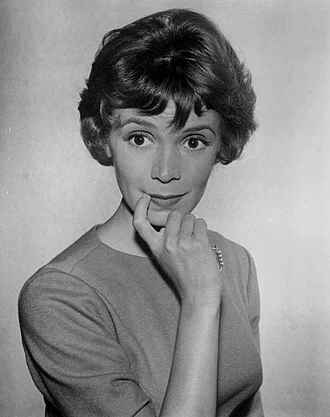
Angel-era publicity portrait (circa 1960)
Publicity portrait
Annie Fargue in a publicity portrait; the original release is undated and the series began in 1960.
Entry point: Angel (1960).
Explore the career in pictures
Updated
Annie Fargue, also credited as Annie Farge or Annie Fargé, was a French actress and producer whose career crossed the Atlantic. American television viewers knew her as the title character of Angel, the CBS comedy in which a French bride adjusts to life with her American husband. In France, her work encompassed theatre, cinema and the production of stage musicals. These are complementary parts of her professional history: the performer familiar from television publicity photographs also worked behind the scenes to bring shows to audiences.
Born Henriette Goldfarb in Etterbeek, Belgium, Fargue moved with her family before the Nazi occupation and later trained at the Conservatoire in France. Her theatre record reaches back to the early 1950s. Les Archives du spectacle lists performances in Nucléa in 1952 and Julien Green's Sud in 1953, followed by work in Andréa ou la Fiancée du matin and Histoire de Vasco. The latter was directed by Jean-Louis Barrault. Those credits place her American television work after an established period on the French stage, rather than at the beginning of her acting life.
By the time Angel was being cast, she was working in the United States and had been an understudy in The World of Suzie Wong on Broadway. Angel paired her with Marshall Thompson as John Smith, an American architect married to her French character, Angel Smith. The series ran on CBS in 1960 and 1961. Its central situation made differences of language and everyday custom part of the domestic comedy. Fargue carried the title role within that format, creating a television identity that remains closely associated with the name under which she appeared in American credits.
The surviving publicity photographs show how Angel introduced that character to viewers. One image in this gallery presents Fargue with a goat identified in the original caption as a wedding gift from Uncle Jacques. The accompanying release was dated December 19, 1960, in advance of an episode broadcast the following January. Another photograph places her beside Chuck Connors for The Rifleman. That press image is dated December 1961, while the episode chronology places her guest appearance in The Princess in January 1962. The publicity dates and broadcast dates describe different stages of the same work.
Fargue returned to work in French theatre and cinema during the 1960s. The stage archive records appearances under Claude Régy's direction in Témoignage irrecevable in 1966 and Harold Pinter's L'Anniversaire in 1967. Cannes lists her among the actors in Mon amour, mon amour, selected for competition in 1967, and Je t'aime, je t'aime, selected in 1968. Her screen credits in the latter identify Agnès de Smet. These roles place her in a different artistic setting from the American domestic sitcom, with stage and film work continuing alongside the transition back to France.
Production became a further part of her career. The Musée SACEM's account of Hair describes her efforts to bring the musical to Paris despite initial resistance to the idea. Her broader production record also includes stage musicals such as Godspell. In film, credits distinguish her work as a producer on Hu-Man from her associate-producer credit on Escape to Victory. These assignments should not be confused with acting parts: they demonstrate her involvement in making productions happen as well as appearing in them. Her career thus linked performance with the practical work of presenting entertainment across different markets.
Fargue died in Neuilly-sur-Seine on March 4, 2011. Her surviving credits leave several routes through her work: the French stage productions of the 1950s, the brief but distinctive American television period, the later French films and the production projects. The gallery concentrates on the television years through three separate publicity photographs, including a portrait, an Angel scene and a Rifleman image. They preserve the particular screen presence through which many viewers first encountered her, while the wider career record reveals a working life that extended well beyond that single sitcom.
Three distinct publicity photographs record a portrait and work on Angel and The Rifleman.
Publicity portrait
Annie Fargue in a publicity portrait; the original release is undated and the series began in 1960.
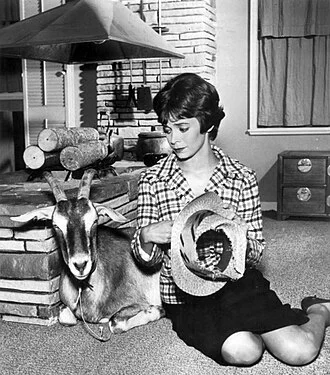
Angel Smith
Annie Fargue with the goat described as a wedding gift from Uncle Jacques; CBS release dated December 19, 1960.
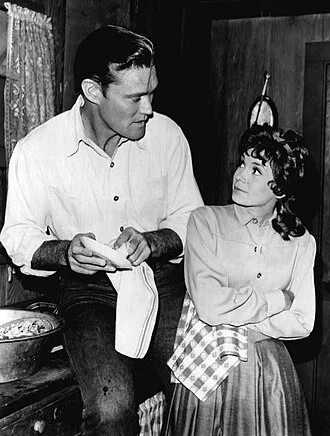
Guest appearance
Chuck Connors as Lucas McCain with guest star Annie Fargue; ABC press photograph dated December 21, 1961.
Annie Farge biography
https://en.wikipedia.org/wiki/Annie_Farg%C3%A9
IMDb: Annie Fargue
https://www.imdb.com/name/nm0267282/
Les Archives du spectacle: stage credits
https://lesarchivesduspectacle.net/p/61883-Annie-Fargue
TVmaze: Angel
https://www.tvmaze.com/shows/47342/angel
Festival de Cannes: Annie Fargue
https://www.festival-cannes.com/en/p/annie-fargue/
Musee SACEM: Hair exhibition
https://musee.sacem.fr/index.php/ExhibitionCMS/ExhibitionCMS/ComplexExhibitions?id=1091
The Rifleman episode chronology
https://en.wikipedia.org/wiki/List_of_The_Rifleman_episodes
TMDB: acting and production credits
https://www.themoviedb.org/person/39442-annie-fargue
Commons: portrait provenance and license
https://commons.wikimedia.org/wiki/File:Annie%20Fargue.JPG
Corrections: hello@dailytimecapsule.com
Work: Annie Fargue.JPG
Creator: Joe Wolhandler Public Relations/McFadden & Eddy
Date: The press release doesn't give the year. The program premiered in 1960
Original source: https://commons.wikimedia.org/wiki/File:Annie%20Fargue.JPG
Primary archive: https://commons.wikimedia.org/wiki/File:Annie%20Fargue.JPG
License: Public domain
License URI: https://commons.wikimedia.org/wiki/File:Annie_Fargue.JPG
Changes: Resized and converted to WebP; portrait also placed in a titled share image. No endorsement implied.
Rights scope: No endorsement implied. See the stated license and modification notice.
Work: Annie Fargue - Angel 1960.jpg
Creator: CBS Television
Date: Press release is dated 19 December 1960-episode aired 5 January 1961.
Original source: https://commons.wikimedia.org/wiki/File:Annie%20Fargue%20-%20Angel%201960.jpg
Primary archive: https://commons.wikimedia.org/wiki/File:Annie%20Fargue%20-%20Angel%201960.jpg
License: Public domain
License URI: https://commons.wikimedia.org/wiki/File:Annie_Fargue_-_Angel_1960.jpg
Changes: Resized and converted to WebP; portrait also placed in a titled share image. No endorsement implied.
Rights scope: No endorsement implied. See the stated license and modification notice.
Work: Chuck Connors and Annie Fargue - The Rifleman 1961.jpg
Creator: ABC Television
Date: 1961-12-21
Original source: https://commons.wikimedia.org/wiki/File:Chuck%20Connors%20and%20Annie%20Fargue%20-%20The%20Rifleman%201961.jpg
Primary archive: https://commons.wikimedia.org/wiki/File:Chuck%20Connors%20and%20Annie%20Fargue%20-%20The%20Rifleman%201961.jpg
License: Public domain
License URI: https://commons.wikimedia.org/wiki/File:Chuck_Connors_and_Annie_Fargue_-_The_Rifleman_1961.jpg
Changes: Resized and converted to WebP; portrait also placed in a titled share image. No endorsement implied.
Rights scope: No endorsement implied. See the stated license and modification notice.